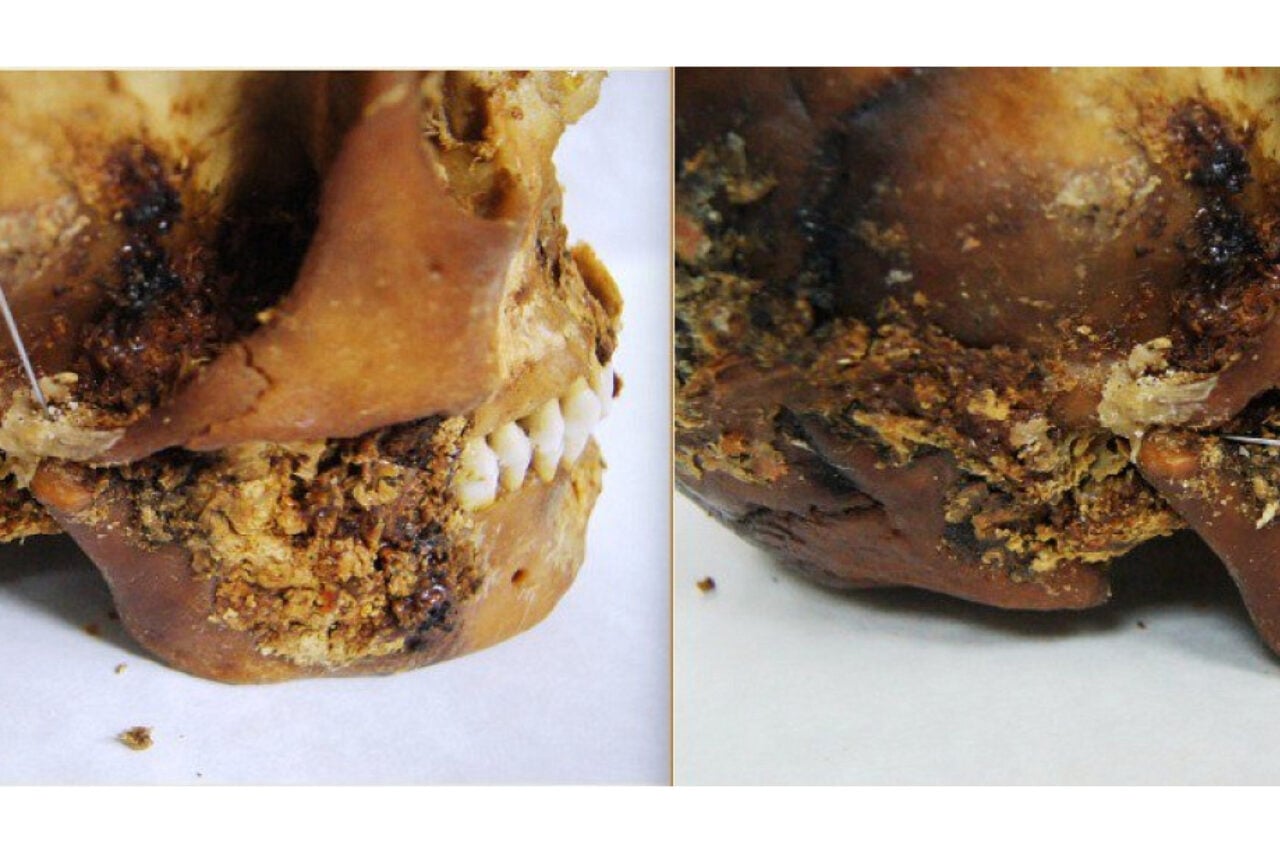
In a remarkable discovery, Russian archaeologists have found evidence of ancient surgical techniques used to save the life of a woman who lived approximately 2,500 years ago. The analysis of her mummified remains, unearthed in 1994 from a small cemetery on the Ukok Plateau, suggests she underwent a complex jaw surgery after sustaining a severe head injury.
Researchers from Novosibirsk State University employed advanced CT scanning technology to examine the skull, revealing signs of extensive trauma and remnants of a primitive prosthetic device. The analysis indicated that the woman had likely received surgical treatment involving an “elastic material” used as a ligature to stabilize her jaw. According to Vladimir Kanygin, head of the university’s Laboratory of Nuclear and Innovative Medicine, the CT scanner provided “non-destructive access to anatomical structures,” allowing for detailed examinations without disturbing the remains.
Insights from the Past
The mummified woman was part of the Pazyryk culture, a nomadic society known for its sophisticated burial practices. Although researchers estimated her age at around 25 to 30 years at the time of death, the limited mummification of her body made it challenging to fully assess her health and lifestyle. Initial examinations were hampered by a patch of preserved skin covering the skull, but the CT scans provided unexpected insights.
The imaging revealed that the woman’s right temporomandibular joint (TMJ) had been severely damaged, likely rendering her unable to eat or speak properly. Further investigations uncovered drilled canals in the joint and potential remnants of a ligament made from horsehair or animal tendon. Interestingly, the condition of her teeth indicated she predominantly chewed with the left side, suggesting she adapted to her injury and survived for some time after the surgery.
Lessons from Ancient Medical Practices
Despite the unexpected nature of this discovery, researchers assert it aligns with what is known about the medical practices of the Pazyryk people. The “Siberian Ice Maiden,” another notable mummy from the same culture, displayed remarkable preservation, indicating a sophisticated understanding of health and injury management among this group. Natalia Polosmak, an archaeologist with the Russian Academy of Sciences, emphasized that the Pazyryk were skilled artisans, adept in creating intricate leather garments, a skill that likely played a role in their surgical practices.
The findings highlight the Pazyryk culture’s deep respect for life, as evidenced by the woman’s burial in a wooden coffin—an important resource in a harsh environment. Although her condition may have limited her contributions to her community, the care she received underscores a societal value system where every individual was honored in life and death. “We don’t know what her personal value to society consisted of,” Polosmak reflected. “In this society, everyone was valued in life simply for their existence and honored after death.”
This extraordinary case not only sheds light on ancient medical practices but also provides a poignant glimpse into the values and beliefs of the Pazyryk culture, illustrating how they navigated the challenges of life in the unforgiving landscapes of southern Siberia.