New research from Texas State University has uncovered significant insights regarding the Pecos River rock art, which dates back approximately 6,000 years. The study reveals that complex metaphysical concepts embedded in this ancient imagery influenced the belief systems of various Mesoamerican cultures. Conducted by a team including Karen Steelman, Ph.D., Carolyn Boyd, Ph.D., and Phil Dering, Ph.D., the findings are published in the journal Science Advances.
Dr. Boyd, the Shumla Endowed Research Professor in the Department of Anthropology at Texas State University, emphasized the importance of these discoveries. “We have securely dated one of the most distinctive rock art traditions in the world — the Pecos River style murals of Southwest Texas,” she stated. The research team utilized 57 radiocarbon dates from 12 sites to establish that Indigenous communities began creating these vibrant murals almost 6,000 years ago.
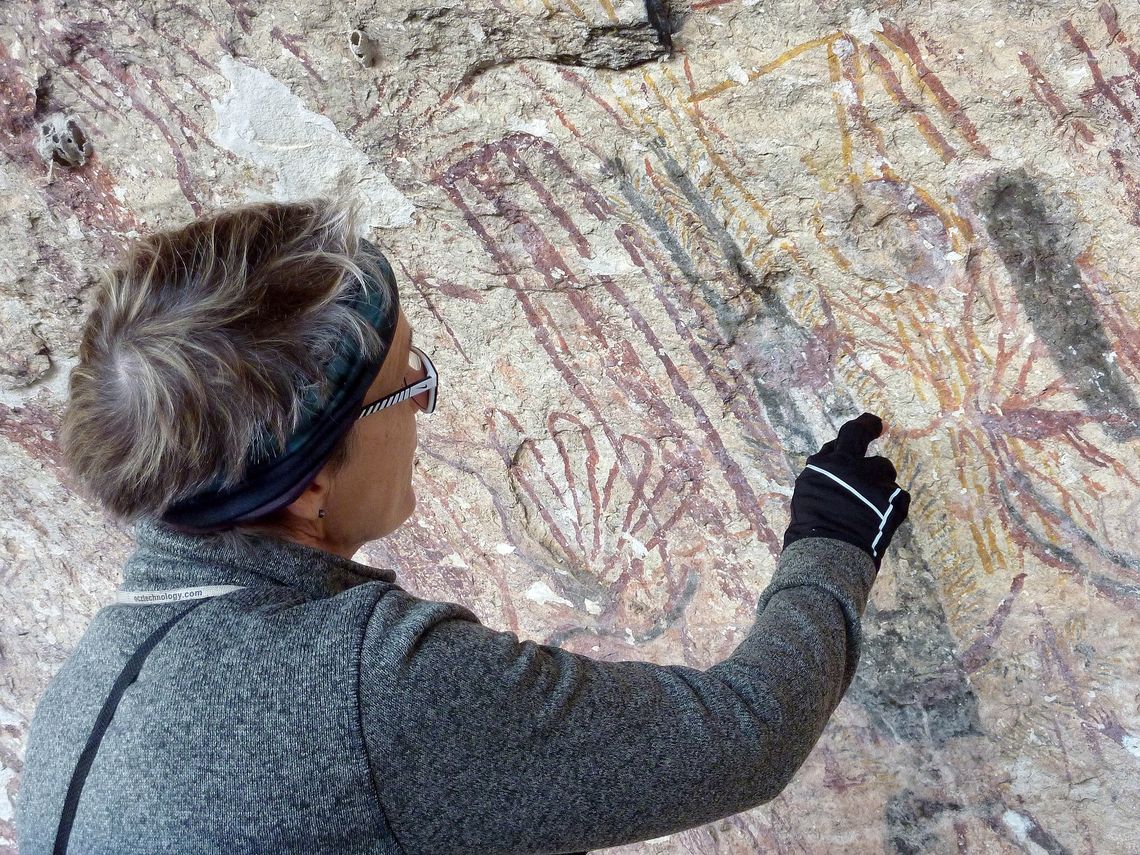
The murals, known as pictographs, depict a variety of figures, including humanlike, animal-like, and geometric shapes. Painted in limestone rock shelters, these multi-colored artworks are arranged in deliberate compositions, with some spanning over 100 feet long and 20 feet tall. The dry desert climate has remarkably preserved these prehistoric creations.
Contrary to previous assumptions that the murals were a result of continuous additions over centuries, the research team’s findings suggest a different narrative. “Another huge shocker is that the dates within many of the murals clustered so closely as to be statistically indistinguishable,” Boyd explained. This indicates that multiple murals may have been produced during a single painting event, forming a cohesive visual narrative instead of a random collection of images.
The researchers employed advanced methods, including plasma oxidation and accelerator mass spectrometry, to obtain 57 direct radiocarbon dates and 25 indirect oxalate dates. Bayesian modeling estimates that the Pecos River style began between 5,760 and 5,385 years ago, likely concluding around 1,370 to 1,035 years ago. Through stratigraphic and iconographic analyses, the team identified that eight of the murals adhered to specific rules and an established iconographic vocabulary, revealing consistent messaging that persisted despite changes in material culture and environmental conditions.
The implications of this research extend beyond mere artistic expression. The Pecos River style paintings, situated within a culturally significant landscape, convey sophisticated metaphysical concepts that have seemingly influenced the beliefs of Mesoamerican agricultural societies. Boyd highlighted the meticulous nature of the murals, stating, “The compositional nature of the murals was further supported by our analysis of the painting sequence.” By using a digital microscope, the researchers discovered that the original artists followed a rule-bound color application order, resulting in complex, sophisticated compositions.
Boyd further noted the enduring relevance of these ancient stories. “Today, Indigenous communities in the U.S. and Mexico can relate the stories communicated through the imagery to their own cosmologies,” she said. This connection underscores the antiquity and continuity of a shared belief system across the New World, which has persisted for at least 6,000 years.
In essence, the canyons of Southwest Texas serve as a vast and ancient library, housing a rich tapestry of painted texts that document 175 generations of sacred stories and Indigenous knowledge. This groundbreaking research sheds light on the profound cultural legacy encapsulated in the Pecos River rock art, illustrating the importance of these murals in understanding the historical and metaphysical landscapes of early civilizations.