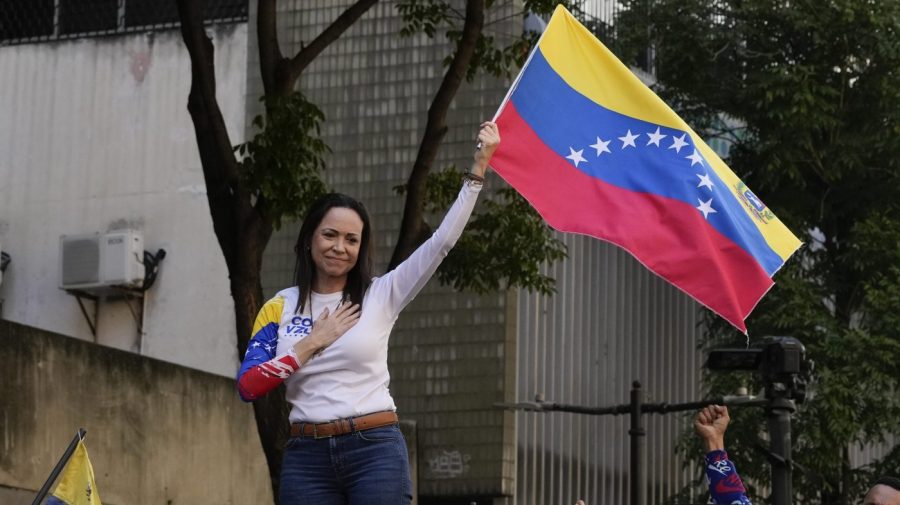
President Donald Trump stated on March 15, 2024, that Venezuelan opposition leader María Corina Machado lacks the necessary support within Venezuela to assume leadership following a recent operation by U.S. troops that resulted in the capture of President Nicolás Maduro. Trump emphasized that Machado had not been consulted prior to the military action, which has significant implications for Venezuela’s political landscape.
During his remarks, Trump expressed skepticism about Machado’s viability as a leader. “I think it would be very tough for her to be the leader,” he remarked, reflecting concerns about her standing among Venezuelan citizens. The operation aimed at removing Maduro has sparked a complex discussion regarding the future of leadership in Venezuela and the role of external powers in shaping the nation’s political future.
The U.S. military operation has drawn mixed reactions both domestically and internationally. Critics argue that such interventions can undermine national sovereignty and lead to further instability. Supporters, however, view the action as necessary to combat the authoritarian regime that has led to economic collapse and humanitarian crises in Venezuela.
Machado, a prominent figure in the Venezuelan opposition, has long been an advocate for democracy and reform in her country. Despite her efforts, Trump’s assertion raises questions about her influence and the potential for a unified opposition front in the wake of Maduro’s removal.
As the situation develops, the focus will shift to the international community’s response and whether there will be a coordinated effort to support a transition of power in Venezuela. Observers are keenly monitoring how the capture of Maduro will affect not only Venezuela’s internal politics but also its relationships with other nations, particularly in Latin America.
The implications of Trump’s comments extend beyond Venezuela, touching on broader themes of U.S. foreign policy and its approach to supporting opposition leaders in authoritarian regimes. As the world watches, the situation remains fluid, with the potential for significant changes in the political dynamics of Venezuela in the coming weeks and months.
In the aftermath of the military operation, it will be crucial for both Venezuelan and international leaders to engage in dialogue that prioritizes stability and democratic governance. The evolving political landscape will require careful navigation to ensure that the aspirations of the Venezuelan people are met while maintaining regional security.