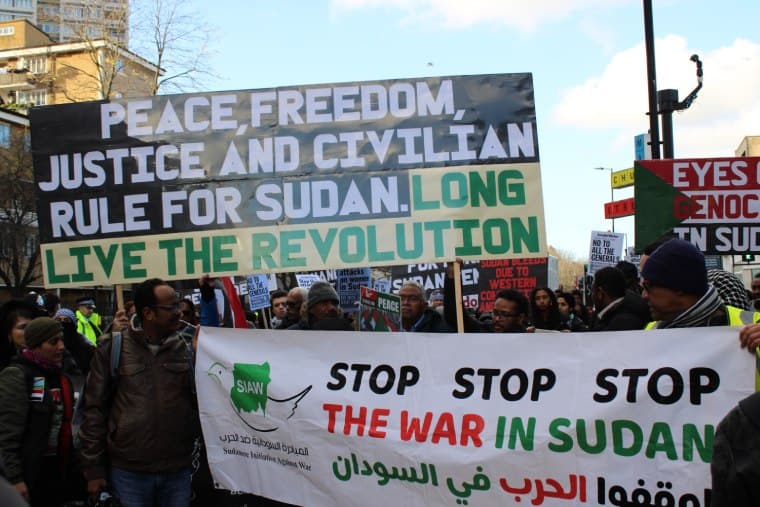
On Saturday, up to 400 Sudanese activists and supporters marched through central London to commemorate the anniversary of the Sudanese revolution that began on 19 December 2018. The demonstrators urged the international community to remember the plight of Sudan as its citizens endure escalating violence and conflict.
The ongoing conflict in Sudan has spiraled since April 2023, when rival factions engaged in a brutal civil war that has claimed approximately 400,000 lives and displaced millions. In a recent briefing to British Members of Parliament, it was revealed that around 150,000 residents of El Fasher in the Darfur region remain unaccounted for following violent clashes. The Rapid Support Forces (RSF) militia’s actions have turned the city, once home to 1.5 million inhabitants, into a site of mass graves, with reports indicating that at least 60,000 people have been killed since the RSF’s assault in October.
The use of sexual violence by militias as a weapon of war has also been reported, intensifying calls from protesters for the British government to cease arms sales to the United Arab Emirates. Activists contend that these weapons have been funneled to the RSF in exchange for Sudan’s gold reserves. While they voiced their concerns over British complicity, demonstrators also cautioned against placing trust in the Sudanese Armed Forces (SAF). Both the SAF and the RSF previously collaborated to stifle the revolution.
During the march, speaker Tasneem lauded the courage of the Sudanese people who rose up seven years ago to demand an end to oppression and dictatorship. “The Sudanese revolution stands as a symbol of resistance,” she stated, emphasizing grassroots efforts toward freedom and democratic governance.
She acknowledged that many in Sudan view the SAF as a potential safeguard against RSF brutality. Yet, she stressed the need to recognize the grave violations committed by the SAF, which continues to act with impunity. “When we see how the world turns its back on the massacres of those in Sudan, it’s not difficult to see them as the only remaining hope,” Tasneem added.
Elbashir from the Sudan Revolution Support Group in Cardiff highlighted the resilience of ordinary Sudanese citizens. He noted the formation of resistance committees that have emerged to support revolutionary demands and protect communities from counter-revolutionary violence. “The Sudanese have shown you how community works, how resilience works. Those very same people have come out now in emergency response rooms. The people are only kept alive by ordinary folk like you and me,” he said.
Miriam, a member of the National Education Union (NEU), spoke about the pivotal role of organized labor in the revolution, referencing a significant strike by 35,000 teachers across Sudan in 2022. “The Sudanese teachers’ committee strike put us in this country to shame with the way they organized,” she remarked, praising the effort to unify representatives from various regions.
The demonstration also mirrored the energy of the Palestine solidarity movement, with participants chanting, “From Gaza to Darfur, stop the killing, stop the war.” A notable presence was a bloc carrying a banner highlighting the demands of prisoners connected to Palestine Action, who are currently on hunger strike in British prisons.
As the situation in Sudan continues to deteriorate, activists in London remain resolute, calling for an end to violence and urging the world not to forget the struggles of the Sudanese people.