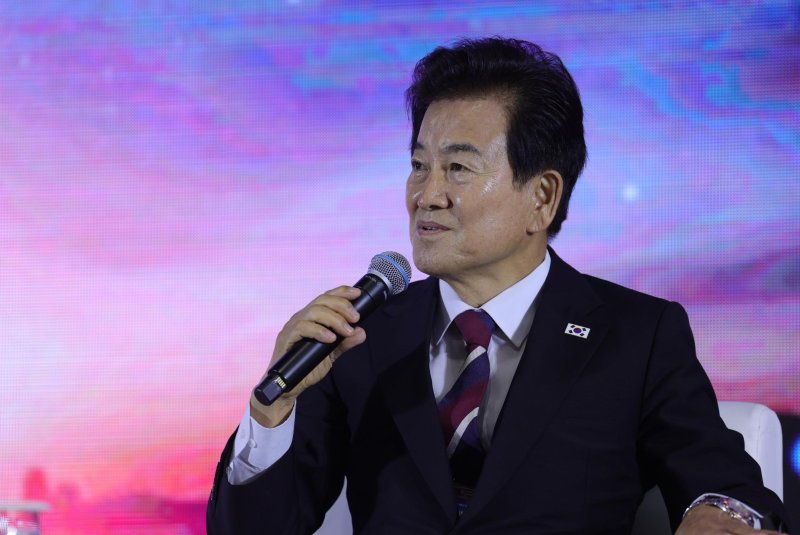
South Korea’s unification policy is facing scrutiny due to what critics describe as a loss of direction, particularly as North Korea appears to be advancing toward a fourth-generation hereditary succession. In a recent column, Cho Young-ki, secretary general of the Korea Foundation for the Advancement of the Korean Peninsula and former professor at Korea University, highlights the implications of North Korean state media coverage of Kim Jong Un‘s daughter, Ju-ae.
Cho notes that Ju-ae’s prominent role during New Year celebrations and her visit to the Kumsusan Palace of the Sun were intentionally staged. This location is significant as it houses the remains of Kim Il Sung and Kim Jong Il, serving as a potent symbol of the regime’s legitimacy. According to Cho, Kim’s return to the palace with Ju-ae on New Year’s Day, particularly after a long absence since late 2023, suggests an intention to elevate her profile ahead of an anticipated party congress.
He contends that this move toward hereditary succession could entrench what he terms “extractive institutions” in North Korea, exacerbating issues of poverty and repression. Such developments create further obstacles to the reunification of the Koreas. Cho contrasts these extractive systems with “inclusive institutions,” arguing that South Korea’s unification strategy should focus on nurturing inclusive political and economic frameworks in the North.
Criticism is directed at the Ministry of Unification, which Cho claims has shifted its focus from a cohesive unification strategy to an approach characterized by engagement and appeasement. He points to recent reports from the ministry that indicate a dismantling of the “North Korean Human Rights Center” and a reframing of “North Korean human rights” as “inter-Korean human rights cooperation.”
Cho warns that this new terminology risks suggesting a false equivalence in the human rights conditions of the two Koreas, thereby downplaying the serious human rights violations that are prevalent in North Korea. He further argues that the ministry’s approach aligns with North Korea’s “two-state” narrative, which he links to Kim Jong Un’s statements from 2023.
The ongoing emphasis by North Korea on strengthening its nuclear capabilities, according to Cho, indicates that the regime has not abandoned its coercive objectives. He dismisses complacent beliefs that Pyongyang would refrain from utilizing nuclear weapons.
Despite a growing public skepticism regarding unification, Cho asserts that the Ministry of Unification must continue advocating for this goal. He emphasizes the importance of a self-directed strategy that safeguards South Korea’s rights and security while also supporting the North Korean populace.
He underscores the critical role of information access as a policy tool, pointing out that North Korea’s efforts to block outside information serve as evidence of its significant impact. Cho calls for an urgent reevaluation of the government’s unification policy framework, stressing that the current trajectory is inadequate for addressing the complex realities on the Korean Peninsula.
The views expressed in this column are those of the author.