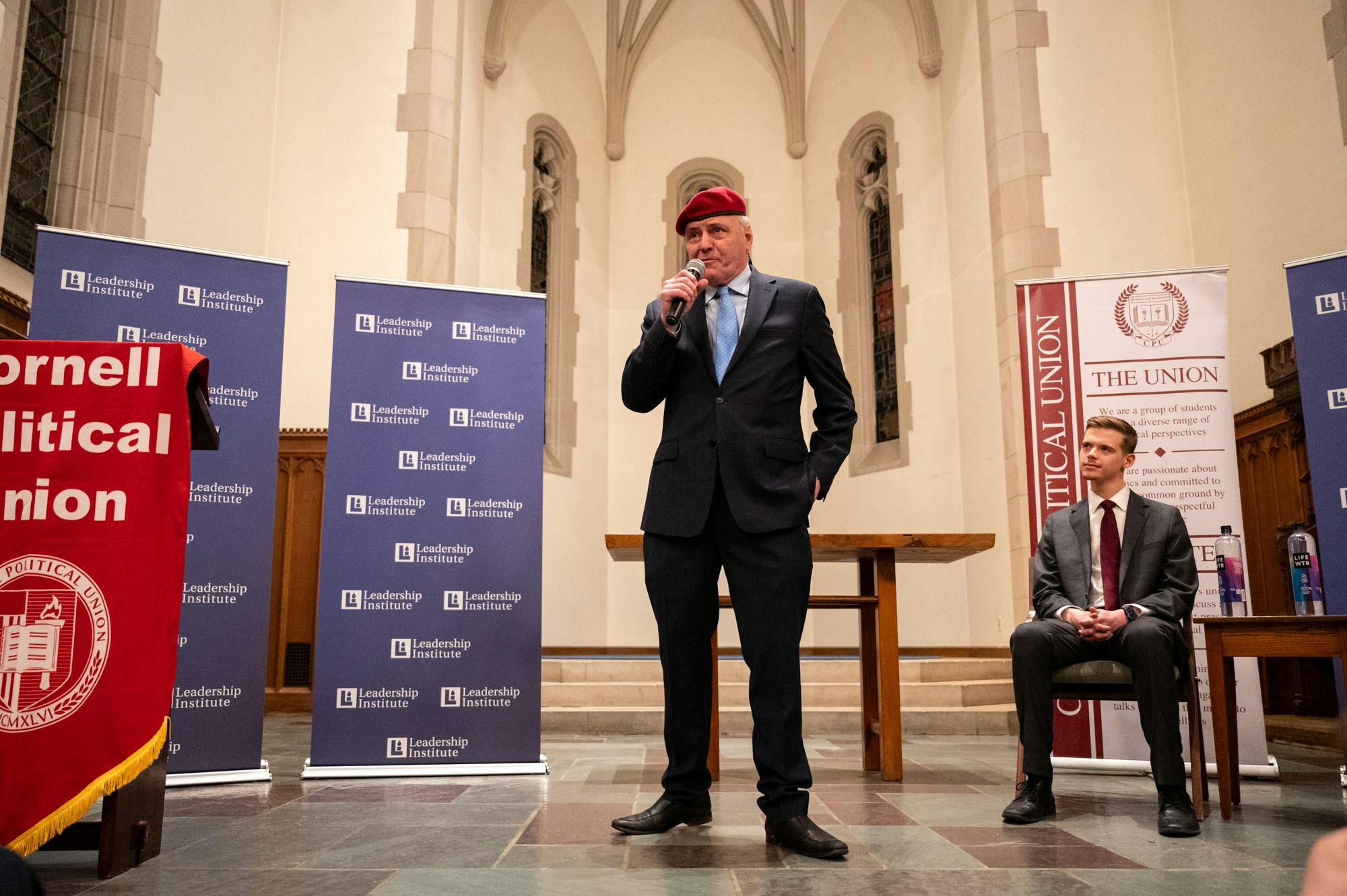
The Cornell Political Union (CPU) hosted a debate featuring Curtis Sliwa, a two-time Republican nominee for mayor of New York City and founder of the Guardian Angels, on March 12, 2024. The event, held at Anabel Taylor Hall Chapel, attracted over 125 students who gathered to hear Sliwa and other debaters discuss the resolution “community over government.”
Sliwa, invited as a guest speaker by CPU, opened the evening with remarks supportive of the resolution. As he entered the chapel wearing his trademark red beret, he received a warm welcome from the audience. “First off, let’s get the rules straight,” Sliwa said, addressing the crowd. “You can’t be glazing me tonight.” He highlighted the importance of community organization, arguing that it is more effective than government intervention. “If you’re just going to wait for the government, they’re going to be a dollar short and a day late,” he stated, urging attendees to take action to enhance their communities.
Born and raised in Brooklyn, Sliwa founded the Guardian Angels in 1979 as a response to rising crime rates in New York City. The organization, which operates in over 130 cities across 14 countries, focuses on crime prevention through safety patrols, self-defense training, and outreach to the homeless. His experience as a community activist propelled him to run for mayor in both 2021 and 2025, where he garnered notable social media support despite receiving only 7% of the vote in the last election.
During his opening remarks, Sliwa criticized the federal government’s failure to protect citizens, particularly in light of recent military actions in Iran. Following U.S. airstrikes, reports indicated that nearly 800 people had been killed in Iran, alongside casualties in Lebanon, Israel, and among U.S. service members. “What the hell did they do over there at this point in our history, to deserve what we’re doing to them?” Sliwa questioned, prompting applause from the audience. He concluded by encouraging students to adhere to their principles rather than financial gain. “Use the great education you’re getting now to make a difference,” he said.
After Sliwa’s remarks, the debate commenced with speeches from CPU members. Leo Glasgow, a Sun opinion columnist, spoke in favor of the resolution, expressing gratitude for his community and cautioning against governmental isolation. “So let me end by saying shoutout to my mom,” he quipped, eliciting laughter from the audience. In contrast, Admir Cekic argued for the primacy of government, citing the Founding Fathers and the Constitution. He emphasized that the government exists to serve communities, ensuring their harmony.
As the debate progressed, various members voiced differing opinions. Max Troiano defended the government’s role in national security, stating, “A beautiful community cannot prevent a war in Iran.” Conversely, Sofia Etlin cautioned against government overreach, asserting that the current generation is more controlled than ever, despite claims of freedom.
Sliwa returned to the podium for closing remarks, commending students for engaging in a discussion that embraced diverse viewpoints. “Trying to collaborate with people of different points of view can be very difficult,” he noted, acknowledging the challenges of navigating negativity in public discourse. Following the debate, a vote was held, resulting in a narrow rejection of the resolution with a tally of 16 to 19.
After the event, CPU members hosted a reception with Sliwa at Okenshields, where he expressed enjoyment for the meal provided. Attendees reflected on Sliwa’s impact. “It was refreshing how much he did not care for establishment figures,” remarked Billy Stammer, a member of the audience. David Rha also shared his thoughts, noting the risks associated with Sliwa’s candidacy in a traditionally liberal space, but found his speech compelling overall.
Throughout the evening, Sliwa’s overarching message resonated with students: strive to make a difference in the world. “What is going to be the mark that you leave on Mother Earth?” he challenged the audience. “You come in with nothing, you go out with nothing. Hopefully, you establish something that has helped other people.”