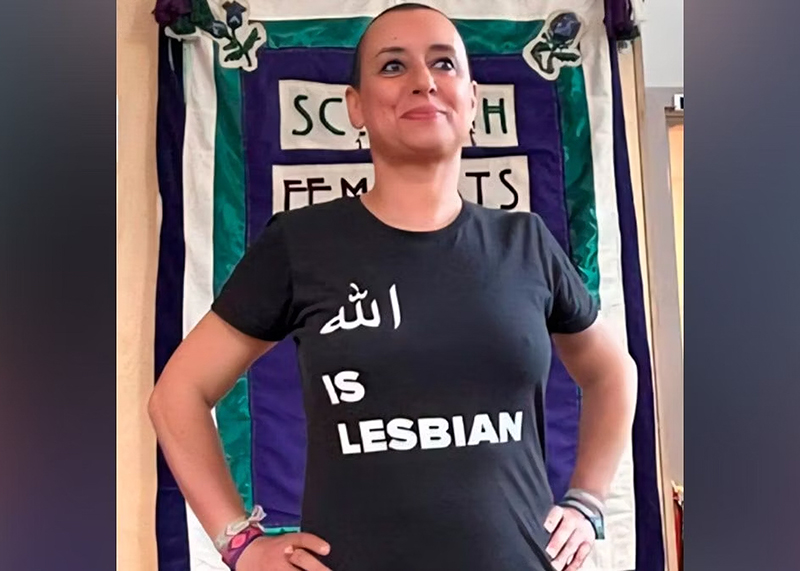
Ibtissame “Betty” Lachgar, a 50-year-old Moroccan lesbian activist, faces severe health challenges while serving a two-and-a-half-year prison sentence for wearing a T-shirt that stated, “Allah is a lesbian.” Lachgar’s condition has reportedly worsened in Salé prison, where she may need to undergo an amputation due to complications from her imprisonment.
Lachgar was sentenced in September 2022 after authorities deemed her social media post offensive to Islam. In her post, she expressed her views on religious ideologies, stating, “You tire us with your sanctimoniousness, your accusations.” The reaction from conservative factions was swift, with calls for her imprisonment and even death threats made via email and social media.
Moroccan law criminalizes insults against Islam, the monarchy, and actions deemed to incite unrest, with penalties reaching up to five years in prison and fines of 500,000 dirhams (approximately $136,130). Despite this, Lachgar’s legal team argues that her conviction contradicts Morocco’s constitution and international agreements protecting freedom of expression.
Health Concerns in Prison
Lachgar is a survivor of bone cancer and has a prosthesis from her left shoulder to elbow. Reports indicate that while incarcerated, she has sustained a fractured elbow and is receiving inadequate medical care. According to her lawyer, Ghizlane Mamounti, “Her prosthesis has completely dislodged, and she’s only being treated with paracetamol… despite urgently requiring complex surgery.”
Her family and legal representatives have expressed grave concerns about her treatment in prison. They claim Lachgar has spent the last six months sleeping on a cold floor without a mattress in a cell with a broken window. The nonprofit organization Avaaz has launched a petition calling for her release, which has gathered nearly 400,000 signatures, marking it as one of the largest petitions targeting Moroccan authorities in the past decade.
Amnesty International has previously highlighted concerns about the treatment of prisoners in Salé prison, alleging instances of physical abuse and torture by guards. The organization’s findings underscore the troubling conditions that Lachgar and other inmates face.
Advocacy and Support
Lachgar is a co-founder of the Alternative Movement for Individual Freedoms, a group advocating for personal liberties, including women’s rights and LGBTQ equality. Her activism has often put her at odds with Moroccan authorities. The T-shirt that led to her conviction was worn as a gesture of solidarity with two LGBTQ activists in Iran who faced execution for promoting homosexuality.
Her sister, Siham Lachgar, expressed the broader implications of her sister’s situation, stating, “This punishment isn’t about her actions, but about what she stands for. It shows that, even today, you can be jailed simply for thinking differently.”
Lachgar’s legal battles and the ongoing campaign for her release reflect a growing movement for human rights and freedom of expression in Morocco. As her health continues to decline, the call for urgent action and proper medical treatment grows louder, shedding light on the complex intersection of activism, law, and personal rights in the region.