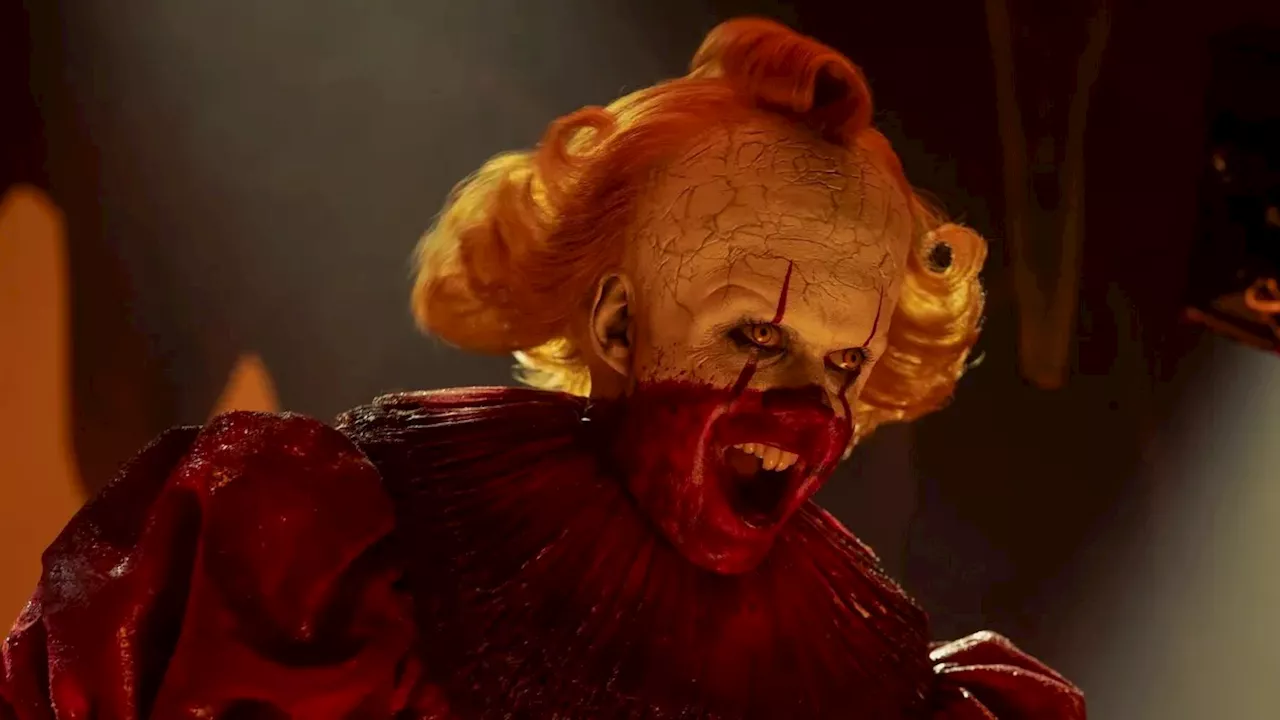
The IT franchise has taken a significant turn as its first season finale introduces intriguing developments surrounding Pennywise and the Losers’ Club. This climax not only reveals new dimensions to Pennywise’s powers but also lays the groundwork for a third film, which is set to explore the origins of the infamous clown and propose a complex narrative involving time loops.
In the finale, viewers learn that Pennywise possesses the ability to see across time, enabling him to target members of the Losers’ Club even before their birth. This revelation challenges the perception of the Losers’ victory, suggesting that their triumph over Pennywise may not be as definitive as previously believed. The upcoming film is likely to delve deeper into the character’s backstory, potentially featuring Bill Skarsgård reprising his role as the titular character.
The narrative surrounding Pennywise is set against a backdrop of generational conflict, where the children of the Losers’ Club will confront the entity both as kids and adults. The series depicts a struggle against evil that spans two generations, culminating in a fierce battle where the Losers ultimately manage to destroy Pennywise through their bonds of love and friendship. Despite experiencing significant losses, they achieve what earlier generations could not: the banishment of the Pennywise entity for a period of 27 years.
The finale further complicates the story by revealing that Pennywise can foresee the moment of his own demise. This foresight allows him to attempt to prevent the birth of his future adversaries, setting the stage for a narrative where he tries to eliminate the ancestors of the Losers’ Club in the past. For instance, when Pennywise confronts Marge Truman, he not only reveals his temporal sight but also indicates that the moment of his defeat coincides with his own inception.
With these revelations, the finale shifts the audience’s understanding of the Losers’ initial victory, suggesting that their battle against Pennywise was merely a temporary measure. It raises the stakes for a potential third film, which could explore the entity’s origins and self-awareness. This new installment may provide insight into how Pennywise assumes various forms before ultimately embracing the persona of Bob Gray, the clown figure that has become synonymous with terror.
The possibilities for a third film are vast, including the potential for a narrative that revisits earlier timelines. This could resonate with themes similar to those found in other adaptations or stories that involve time travel. As the narrative unfolds, it offers ample opportunity for Skarsgård to further develop his portrayal of Pennywise, delving into aspects of the character and lore that were not fully explored in Stephen King’s original novel.
For fans of the franchise, the expansion of the IT universe promises not only deeper character exploration but also a chance to see how these elements interact with the established lore. While some purists may have mixed feelings about deviations from the source material, the prospect of more content featuring Skarsgård is seen as a positive development.
As the franchise prepares for its next chapter, audiences can anticipate a richer understanding of Pennywise and the Losers’ Club, with storytelling that pushes the boundaries of fear and friendship. The future looks bright for the IT franchise, and fans are eager to see how these new dimensions will unfold in upcoming projects.