The Honolulu Police Department (HPD) and the state Department of Education (DOE) have initiated a pilot program that positions police officers in three high schools on Oahu—Waianae, Kapolei, and Kaimuki—throughout the current academic year. This initiative represents the first structured School Resource Officer (SRO) program on Oahu, drawing inspiration from similar programs previously established on Maui, Kauai, and the Big Island. Officials assert that these existing models have focused on mentorship and relationship-building rather than enforcing routine school discipline.
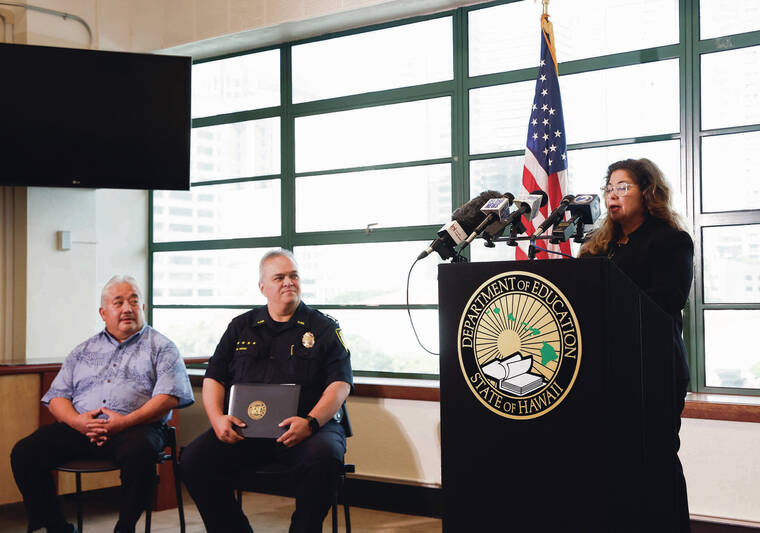
Interim HPD Chief Rade Vanic emphasized the collaborative nature of the program’s design during a news conference at the DOE headquarters in Honolulu. “The focus is simple — build relationships, earn trust and make sure officers on campus are there to mentor our students, not replace school discipline,” Vanic stated. The selection of the three high schools was made jointly by HPD and DOE, considering factors such as operational needs and school readiness.
The initiative seeks to test the effectiveness of the program across different operational structures within HPD. According to Vanic, “The way our department is broken up is we have central patrol and regional patrol. So because this was a pilot, we wanted to test what operations would be like in each of those different operations.” Each school offers unique programming opportunities, with Kapolei High already having a law enforcement career pathway, while Waianae High is in the process of developing one. Kaimuki High is investigating a first responder pathway that introduces students to careers in police, fire, and emergency services.
This pilot program comes in response to escalating concerns regarding youth violence, bullying, and crime, particularly on Oahu’s west side. Community leaders have called for more effective engagement with students following several alarming incidents. For instance, a viral video in September captured a student assault near Nanakuli High and Intermediate School, sparking outrage among parents and community members. Additionally, five students at Kalama Intermediate School in Maui were arrested in October for alleged kidnapping related to bullying, while a special-needs student in Wahiawa was assaulted in April, leading to multiple charges against involved parties.
In light of these incidents, Rep. Darius Kila (D, Nanakuli-Maili) expressed his disappointment that Nanakuli High was not included in the initial rollout of the program. In a letter to Vanic, Kila highlighted the urgent need for intervention, noting, “We have seen an uptick in youth violence throughout our Westside communities. Having Nanakuli High School included in this program is not just a matter of fairness, it is a matter of urgency.”
Addressing these concerns, Vanic clarified that the initial school selections aimed to evaluate the pilot across different operational frameworks while aligning with the DOE’s objectives. Waianae and Kapolei High Schools were chosen first, with Kaimuki added later due to strong interest from HPD personnel. The three schools are expected to participate through the current school year, with the potential for continuation into the following year.
Vanic noted that expansion might be explored after assessing the pilot’s impact. “This pilot will run through the 2025-2026 school year, and at the end of the year, HPD and DOE will evaluate the impact, identify adjustments and explore future funding opportunities,” he stated. Officers involved in the program will not replace school discipline, focusing instead on legitimate safety and criminal concerns. “School discipline remains the responsibility of school administrators. That doesn’t change,” he reaffirmed.
The hope is that a consistent police presence will help mitigate violence and criminal activity while reducing the burden on patrol officers responding to campus-related calls. “We’re hoping to reduce the violence and reduce the criminal activity that we’re seeing,” Vanic said, adding that arrest would be considered a last resort.
The dedicated officers will also take on educational roles, conducting presentations on topics such as bullying and anti-bullying strategies. The program, funded by HPD, allocates approximately $96,000 annually per officer, with three officers assigned to each school. Many of the officers are retired members of the HPD who have been reinstated specifically for this role.
HPD Officer Jayson Kauwenaole, assigned to Kapolei High, highlighted the intentional selection of officers with a commitment to mentoring. “Everyone that has been selected has a history of and knowledge of not only on the police department side, but has interest in mentoring kids,” he said. Kauwenaole emphasized the importance of creating an approachable presence on campus, stating, “We don’t want them to be intimidated by us. We want them to feel free to come and let us know if there’s things going on in their life.”
Schools Superintendent Keith Hayashi remarked that the frameworks established by neighbor island SRO programs have informed the pilot’s design. He noted, “Those partnerships have shown us that when implemented thoughtfully, SROs can play a positive role in schools by building relationships, serving as mentors and working closely with educators.”
Emphasizing the pilot’s limited scope, Hayashi added, “Starting with a small number of schools allows us to be thoughtful, responsive and accountable as the program moves forward.”
Waianae High School Principal Ray Jeanine Pikelny-Cook echoed the importance of relationship-building, particularly for students affected by socioeconomic challenges. “With the SROs, I do want them to see law enforcement not just as enforcers but as mentors,” she said. Pikelny-Cook believes the program could significantly benefit at-risk students, stating, “Certain kids will gravitate towards talking to them. Students really need to build relationships with law enforcement because it will go into the community.”