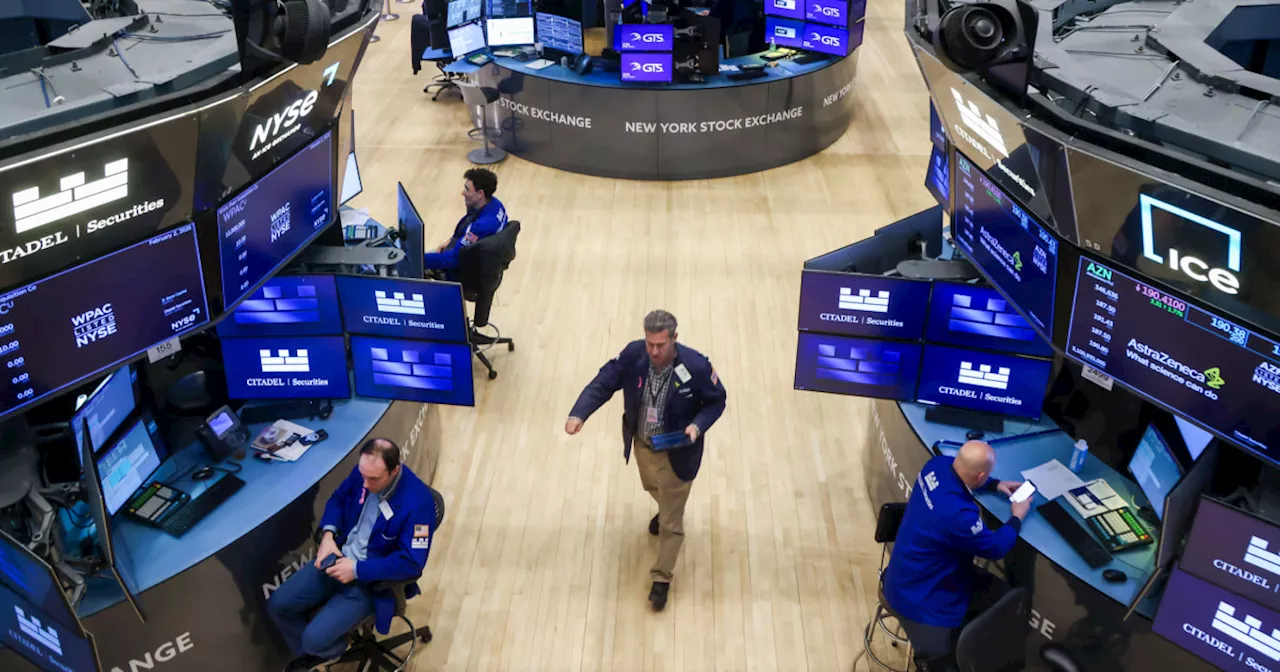
The financial markets experienced a significant rebound on Friday, with the S&P 500 rising by 1.97%—its best single-day performance since May—following a week marked by intense selling. The Nasdaq Composite also surged, increasing by 2.18%. This recovery came after a dramatic series of declines, primarily driven by concerns surrounding the rapid expansion of artificial intelligence (AI) and its implications for the economy and labor market.
Despite the overall market uptick, several major technology companies saw sharp declines in their stock prices. Notably, shares of Amazon, the fifth-largest public company globally, plummeted by 5.58% after announcing plans to invest $200 billion over the coming year, predominantly in its Amazon Web Services division, the leading cloud service provider. Since the start of the week, Amazon’s stock has fallen approximately 12%, resulting in a loss of over $310 billion in market value.
Other tech giants faced similar challenges. Both Microsoft and Meta disclosed plans for substantial investments in AI, each also projecting spending in the hundreds of billions. Collectively, Amazon, Microsoft, Meta, and Alphabet are expected to allocate around $650 billion this year to enhance their data center and AI capabilities. Over the past week, these four companies have together lost nearly $1 trillion in market value.
Market Dynamics and Sector Performance
While the broader market indices struggled throughout the week, certain sectors showed resilience. Industrial stocks, particularly Caterpillar, and select energy companies surged as expectations grew that their services would be in high demand for data center operations. The industrial and energy sectors of the S&P 500 were among the top performers on Friday.
In the technology sector, semiconductor companies also experienced gains, with shares of Nvidia soaring by nearly 8%. The AI chip manufacturer is now valued at over $4.5 trillion. Nvidia’s CEO, Jensen Huang, defended the high levels of investment in AI, stating that the spending is justified given the “incredibly high” demand for AI applications.
In contrast, Apple saw a significant increase of 7% this week. The iPhone maker has largely avoided the negative impacts related to AI apprehensions due to its strategy of purchasing cloud computing capacity rather than investing in its own data centers.
The sell-off began earlier in the week when AI developer Anthropic announced advancements in AI agents capable of performing sophisticated tasks like data analytics. This news sparked panic among investors in software and data analysis companies across various sectors, including real estate and banking. The resultant fear that AI could disrupt their businesses led to heavy selling in the tech sector.
The turmoil also impacted private credit firms, which are instrumental in financing many leading software and data companies. These firms experienced substantial declines, reflecting the growing uncertainties surrounding AI investments.
Interestingly, the Dow Jones Industrial Average reached a milestone of 50,000 for the first time, a notable achievement that attracted attention. However, this index comprises only 30 stocks, making it less representative of the overall market compared to broader indices like the S&P 500. Despite the Dow’s rise, the S&P 500 remains up less than 1% for the year.
Cryptocurrency Fluctuations
In the cryptocurrency market, Bitcoin exhibited extreme volatility, swinging nearly $10,000 within 24 hours. The cryptocurrency dipped close to $60,000 late Thursday but rebounded to over $70,000 by Friday evening. The unpredictable nature of crypto often sets it apart from more traditional assets such as stocks and bonds. Paul Donovan, chief economist at UBS Global Wealth Management, remarked that “crypto is not an asset, and is held by a tiny portion of society,” suggesting that recent market fluctuations are unlikely to alter consumer behavior significantly.
On a different note, smaller stocks outperformed their larger counterparts, with the Russell 2000 index rising nearly 4% on Friday. Analysts at Bank of America expressed optimism for smaller companies, stating, “We are long Main St., short Wall St.” They indicated that until former President Donald Trump’s approval ratings improve, smaller stocks may continue to see favorable conditions.
This week’s market dynamics highlight the complexities of the current economic landscape as companies navigate the implications of AI advancements while investors react to the volatility within and beyond traditional markets.