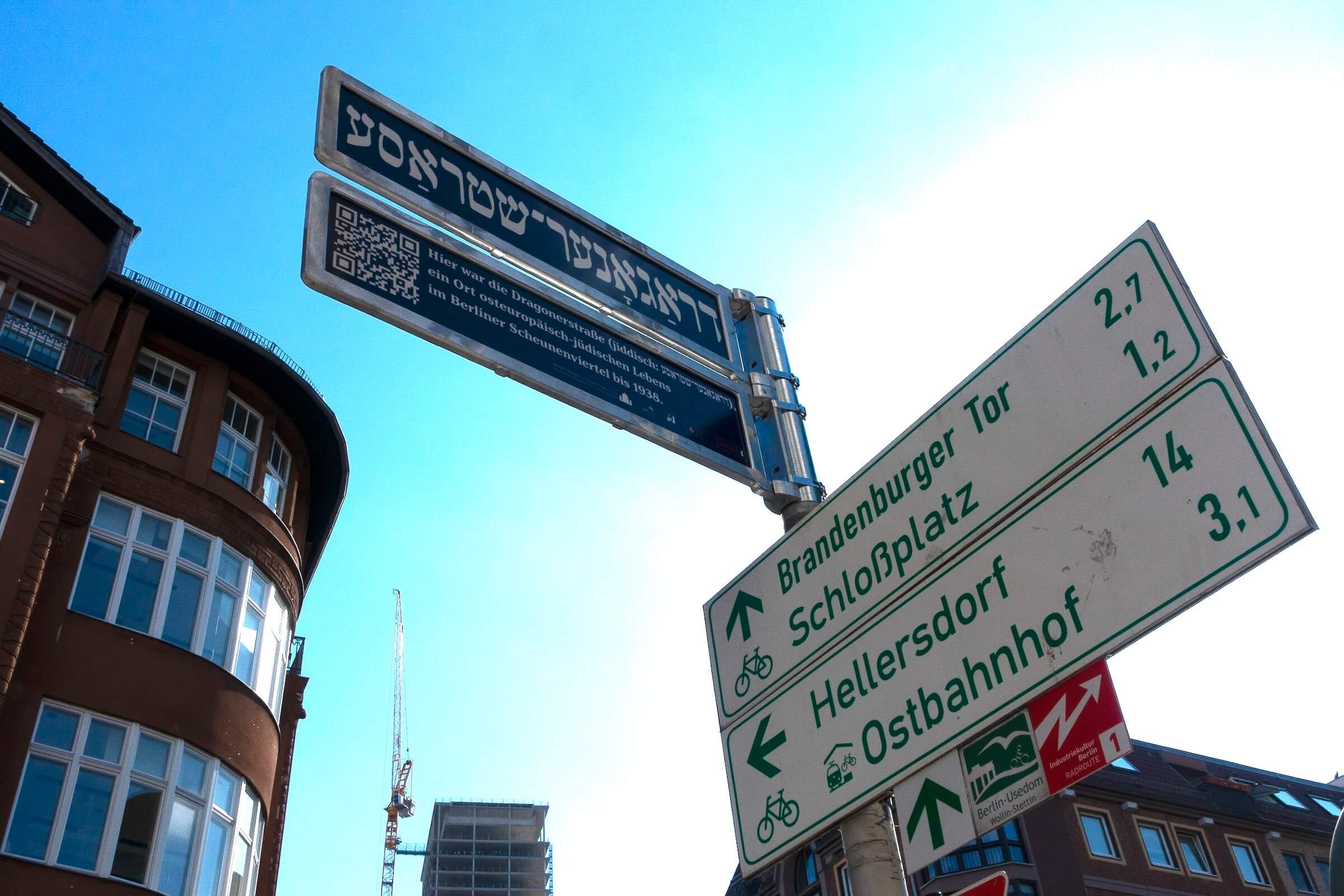
Berlin has officially unveiled a series of Yiddish street signs in its historic Jewish quarter after a prolonged battle with bureaucratic hurdles and cultural politics. The new signs mark a significant moment for Yiddish language recognition in Germany, a country where Yiddish is still not an officially recognized minority language.
The unveiling took place on March 11 in central Berlin, on the corner of the former Grenadierstrasse—once the city’s most visibly Jewish street. Artist Sebestyén Fiumei first drew attention to the issue in spring 2021 by illegally installing a white Yiddish sign on a street pole, mimicking the official German sign but featuring the street’s historical name in Yiddish script. Authorities quickly removed it, but the act sparked a debate about how Germany commemorates its Jewish heritage.
Jewish district official Nathan Friedenberg and historian Jess Earle pushed for authorized Yiddish markers that would honor the working-class Yiddish-speaking residents who lived in the area before the Holocaust. Despite significant resistance—regulations almost banning the use of Yiddish entirely—the project secured permission for 10 official signs.
Yiddish’s Struggle for Cultural Recognition
For decades, Yiddish—a language spoken by 85% of murdered European Jews—has been absent from Germany’s public memory despite its roots in Ashkenaz, the historic Jewish homeland in Germany. The Holocaust shattered hopes for assimilation, nearly eradicating Yiddish speakers. Today’s Jewish population in Germany mainly descends from Eastern European immigrants, many from the former Soviet Union, who maintain cultural and linguistic ties to Yiddish.
Sasha Lurje, a Latvian-born Yiddish singer based in Berlin, expressed strong emotional ties to the old Jewish quarter where the signs were installed. “I deeply connect to the people who once lived in the Jewish quarter,” she said, emphasizing the revival of Yiddish culture through numerous musical and literary events taking place across Berlin, including by the organizations Shtetl Berlin and Yiddish.Berlin.
However, even at the March 11 unveiling in front of about 30 attendees, no Yiddish was spoken publicly. Earle stated, “Yiddish isn’t the focus. It’s only mentioned when completely necessary,” spotlighting ongoing tensions between commemorative visibility and genuine linguistic presence.
Comparisons to Other Minority Languages in Germany
The Yiddish signs come amid wider discussions about minority languages in Germany, where languages like Lower and Upper Sorbian enjoy official protection and visible bilingual signage in Lusatia, a region 70 miles from Berlin. The Sorbian community benefits from government funding, dedicated schools, research institutes, cultural programs, and legal protections secured under the European Charter for Regional or Minority Languages.
Language activists like Měto Nowak, who leads efforts for recognized minority languages, question why Yiddish remains excluded. Nowak highlighted that Yiddish is an official minority language in eight European countries and pointed to efforts in Sweden as a model. He recently published an article about the Yiddish sign project in Lower Sorbian and expressed hope for renewed recognition campaigns.
Renewed Efforts to Recognize Yiddish as a Minority Language
Notably, Fiumei and his former roommate, Eliana Jacobs, launched a campaign alongside their public art to secure minority status for Yiddish in Germany. Though dormant for years, the initiative has reignited with new public visibility following the signage unveiling.
“Let’s relaunch the campaign! It’s very realistic,” Jacobs said, echoed by Lurje’s confidence in the renewed momentum.
Without official recognition, Yiddish remains largely invisible in Berlin’s public sphere despite the city’s growing vibrant Yiddish cultural scene. The unveiling signals a critical step but also highlights the challenges ahead in preserving and honoring the language’s legacy in Germany.
For Colorado and U.S. readers, this story underscores global struggles over minority language recognition and how communities resist cultural erasure even in the face of bureaucratic inertia and historical trauma. It also resonates in immigrant-rich communities across the U.S. striving to maintain linguistic heritage.
The project includes a QR-coded plaque linking to “Without a trace?”, a website documenting the history of Berlin’s Yiddish-speaking population. Supporters hope this initiative will inspire similar campaigns for minority language recognition in the U.S. and abroad.
“When I first heard children speaking the language, I almost cried,” said Sorbian linguist Evan Bleakly on the emotional power of language revitalization efforts.
As Berlin renovates its memory landscape, the fight to give Yiddish an official voice captures both heartbreak and hope for Jewish culture and minority languages worldwide.