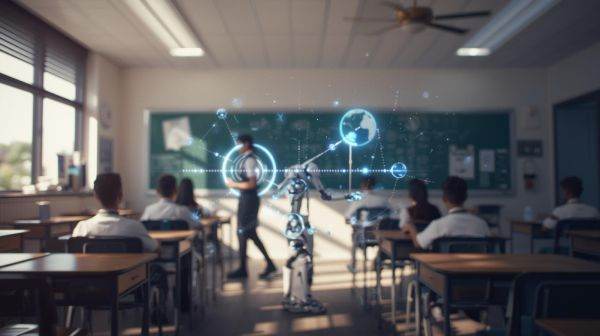
The rector of the West University of Timișoara (UVT), Marilen Pirtea, has issued a warning about the potential risks associated with the rising use of Artificial Intelligence (AI) in education. He emphasizes that without clear institutional regulations, the integration of AI could undermine the meaningfulness of the learning process. This concern aligns with broader global discussions regarding the impact of AI on educational systems.
In response to these challenges, the UVT has implemented an internal regulation aimed at establishing an ethical and pedagogical framework for the use of generative AI in its educational processes. According to Pirtea, the university is committed to ensuring that it remains “up to date” with the ethical implications of AI. The recently adopted regulation formalizes the guidelines for using generative AI, intending to integrate this technology on solid pedagogical foundations while avoiding potential pitfalls.
The rector highlighted insights from the report titled “A New Direction for Students in an AI World: Prosper, Prepare, Protect“, published in January 2026 by the Brookings Institution. The report identifies a significant gap: AI has infiltrated students’ lives much faster than it has been integrated into schools. Tools such as generative language models are increasingly used by children for various purposes, including homework assistance and social interactions, often outside any structured educational framework.
Pirtea pointed out the importance of recognizing that learning is not solely a cognitive activity; it is inherently social and emotional. Effective education relies on relationships with teachers and peers, motivation, self-regulation, and the establishment of meaning. One critical concern raised by the rector is the risk of “externalizing thinking” to algorithms. He warns that outsourcing cognitive processes to AI could hinder the development of essential cognitive skills among students, weakening the human connections that are fundamental to education.
While AI presents opportunities to enhance educational access and support personalized learning, Pirtea stresses that these benefits can only be realized through deliberate and responsible integration. Without well-defined frameworks, the risks may outweigh the advantages, leading to dependency on AI tools and a decline in critical thinking capabilities. Additional concerns include negative impacts on socio-emotional development, erosion of trust in educational institutions, and the widening of existing educational inequalities.
These challenges are not limited to students; the academic environment is also experiencing similar tensions. The use of AI tools for writing, synthesis, and assessment has become commonplace among students, while educators employ these technologies for planning and evaluation. The rector describes a central risk: the potential shift of cognitive effort towards AI tools, which could redefine what constitutes authentic learning.
In light of these complexities, there is an urgent call for universities to establish clear regulations regarding the use of AI. Institutions are encouraged to integrate AI thoughtfully into their educational missions, clarifying which skills need to be developed in an increasingly technology-assisted world and identifying aspects of teaching, assessment, and mentoring that should remain uniquely human. The goal is to foster an educational environment that not only embraces the potential of AI but also safeguards the critical elements of learning that define meaningful education.