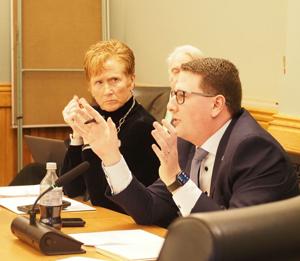
Legislation enabling Iowa community colleges to offer four-year degrees has successfully passed a significant hurdle in the Iowa House. On March 27, 2024, the Iowa House Higher Education Committee advanced House Study Bill 533, which aims to expand educational opportunities in rural areas. This initiative has faced substantial opposition from private colleges in Iowa, concerned about competition.
The amended bill now proposes a pilot program allowing select community colleges to begin offering bachelor’s degrees in specific fields. Committee chair Rep. Taylor Collins, a Republican from Mediapolis, described this legislation as potentially the most significant reform of the community college system in Iowa since its establishment nearly six decades ago. He emphasized the need for such programs to address workforce gaps in education, nursing, and other essential sectors. “I believe we can close these workforce gaps, and this bill does exactly that,” Collins stated.
Under the revised proposal, only community colleges located more than 50 miles from the main campus of a public or private university that already offers similar programs would qualify to develop bachelor’s degree offerings. The programs must align with regional workforce needs and should focus on areas like nursing, education, information technology, public safety, business, health care management, agriculture, or dental hygiene. Colleges will be limited to offering no more than three bachelor’s degree programs each.
The pilot will require participating colleges to submit regular reports to the Iowa Department of Education and the General Assembly, detailing enrollment figures, completion rates, workforce outcomes, and tuition challenges. This data will help assess the program’s impact and determine future expansions.
Rep. Timi Brown-Powers, a Democrat from Waterloo, supported the amended bill, labeling it a “good starting point” for addressing the educational needs of individuals who may be geographically constrained or struggle with online learning formats. Following the committee’s approval, the bill will move to the Iowa House floor for further debate.
In addition to the degree legislation, the committee also discussed other important bills impacting university operations. An amendment to House Study Bill 538 proposed changes to the presidential search committees at state universities. This amendment allows for a more diverse representation of stakeholders in the selection process, including a student member and a faculty senate member.
Despite these changes, some legislators raised concerns about the degree of control exerted by the legislature. Rep. Heather Matson, a Democrat from Ankeny, expressed unease about the potential diminishment of community partnerships and civic engagement due to increased legislative oversight.
The committee also advanced House Study Bill 531, which aims to freeze tuition for all students until July 2031. This legislation was refined to focus solely on tuition, excluding mandatory fees. Rep. Dave Jacoby, a Democrat from Coralville, introduced several unsuccessful amendments aimed at expanding the freeze to include private K-12 schools receiving state vouchers and increasing state support for university operating budgets. He emphasized the need for a broader focus on student investment, rather than solely institutional funding.
Another significant bill, House Study Bill 540, addresses the responsibility of public universities regarding defaulted educational loans. Initially proposing that universities cover 25% of such debts, the committee amended the legislation to reduce this liability to 10%. Collins indicated that this approach ensures universities are accountable for providing quality education that leads to viable employment outcomes.
Concerns were also raised regarding House Study Bill 544, which seeks to establish a tax on university endowments. The proposed tax threshold was raised from $250 million to $500 million, with the tax rate adjusted to align with the highest corporate tax rate. Collins stated that funds generated from this tax would support scholarships for students entering high-demand job fields. However, Brown-Powers cautioned that this approach could deter donations to impacted universities.
Legislation advancing without amendments included House Study Bill 541, which mandates the board of regents to explore a performance-based funding model for state universities. Critics, including Matson and Jacoby, voiced concerns based on negative experiences with similar funding structures in K-12 education. Collins defended the bill, suggesting that many states have successfully implemented performance-based funding and that this proposal merely tasks the board with studying the concept.
As the Iowa House prepares for further discussions, the outcomes of these legislative efforts could significantly reshape the educational landscape in the state.