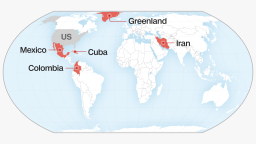
US President Donald Trump signaled a potential military expansion to target Mexican drug-trafficking organizations, following the recent US action against Venezuelan leader Nicolás Maduro, who has been accused of “narco-terrorism.” During an interview on the program “Fox and Friends,” Trump emphasized the need for action regarding drug cartels in Mexico, stating, “We have to do something.” He noted that the Mexican government has consistently dismissed his offers to assist in dismantling these criminal organizations.
In remarks made on Thursday, Trump reiterated his plans to focus on land operations against the cartels, claiming, “We’ve knocked out 97% of the drugs coming in by water, and we are gonna start now hitting land.” Mexico, recognized as the primary source of fentanyl entering the US and a crucial transit point for Colombian cocaine, could appear to be a logical target for Trump’s proposed military campaign. Yet, experts highlight that the reality of Mexico’s drug trafficking landscape is considerably more complex than Trump’s portrayal of a few dominant cartels.
Complexities of the Drug Trade
Historically, Mexican cartels have been depicted in various forms of media as hierarchical organizations led by notorious figures such as Joaquin “El Chapo” Guzmán. Throughout the 1980s and 1990s, a handful of cartels controlled much of the drug trafficking. Today, however, the situation has transformed dramatically. According to Eduardo Guerrero, director of Lantia Intelligence, approximately 400 different groups now operate across Mexico, a stark contrast to the earlier model of a few dominant organizations.
“The biggest ones have become more sophisticated and more complicated,” Guerrero stated, noting that the Jalisco New Generation Cartel, one of the most powerful, has expanded from around 45 organizations to approximately 90 in recent years. This fragmentation necessitates a more nuanced and sophisticated strategy to counter the cartels effectively.
Historically, the Mexican government has pursued a “kingpin” strategy, targeting prominent cartel leaders in an effort to disrupt the drug trade. This approach, which intensified around 2007 with the support of US intelligence and resources, aimed to dismantle the cartels by removing their leadership. Despite numerous arrests and killings of high-profile figures, the flow of drugs into the US has persisted, with new leaders quickly emerging to fill the void.
Challenges to Control and Governance
Analysts argue that the kingpin strategy has backfired, resulting in the fragmentation of cartels into smaller, more violent factions that compete for territory and control. The cartels have evolved into complex economic networks, providing jobs and imposing control over legitimate businesses, including agriculture and transportation. A study published in Science magazine estimated that cartels employ between 160,000 and 185,000 individuals across the country.
“No one is firmly in control, neither the cartels nor the government,” noted Falko Ernst, a researcher specializing in Mexican organized crime. The power dynamics vary significantly across regions, with some areas firmly under government control while others are dominated by armed groups. This diverse landscape complicates any singular strategy to address the issue, as “power, conflict, violence, drugs, and crime don’t follow one model,” Ernst added.
The intertwining of criminal organizations with political structures has further complicated the scenario. This connection became evident during the 2024 national elections, where crime groups sought to influence local governance by installing their own candidates. The intimidation tactics employed by these groups resulted in the deaths of approximately three dozen candidates, while hundreds more withdrew from the race due to fear.
In light of these complexities, Benjamin T. Smith, author of “The Dope: The Real History of the Mexican Drug Trade,” emphasized that merely removing cartel leaders will not dismantle the entrenched structures that support them. “As long as you have a major demand for the drugs, you’re not going to get rid of the supply,” he explained.
Amid this challenging environment, Claudia Sheinbaum, the current mayor of Mexico City, has expressed her opposition to the idea of US military intervention in Mexico. She highlighted the importance of national sovereignty, stating that while she is willing to collaborate with the Trump administration, she does not intend to accept orders from Washington. Sheinbaum has already taken steps to address drug trafficking by deploying thousands of troops to the US-Mexico border.
Trump’s comments have raised concerns about the potential for destabilizing violence, as seen in the Pacific state of Sinaloa last summer. In an operation that allegedly involved US coordination, a Sinaloa cartel leader was apprehended, leading to internal conflicts within the cartel that resulted in significant casualties.
Sheinbaum has taken initiatives to tackle the drug crisis, including transferring key drug-trafficking suspects to the US and ramping up military presence at the border. She cautioned that unilateral US military intervention could severely damage diplomatic relations between the two countries, which have become critical trading partners.
While Trump continues to assert the need for action against the drug problem, Sheinbaum remains hopeful that the two nations can maintain a cooperative relationship. “There has been very good communication” with the Trump administration, she stated, but she remains skeptical about the likelihood of military action being pursued.
The evolving dynamics of power and influence in Mexico present a formidable challenge for both the Mexican government and the United States. As Trump’s administration navigates its approach to combating drug trafficking, the complexities of the situation may require more than military solutions to achieve lasting results.