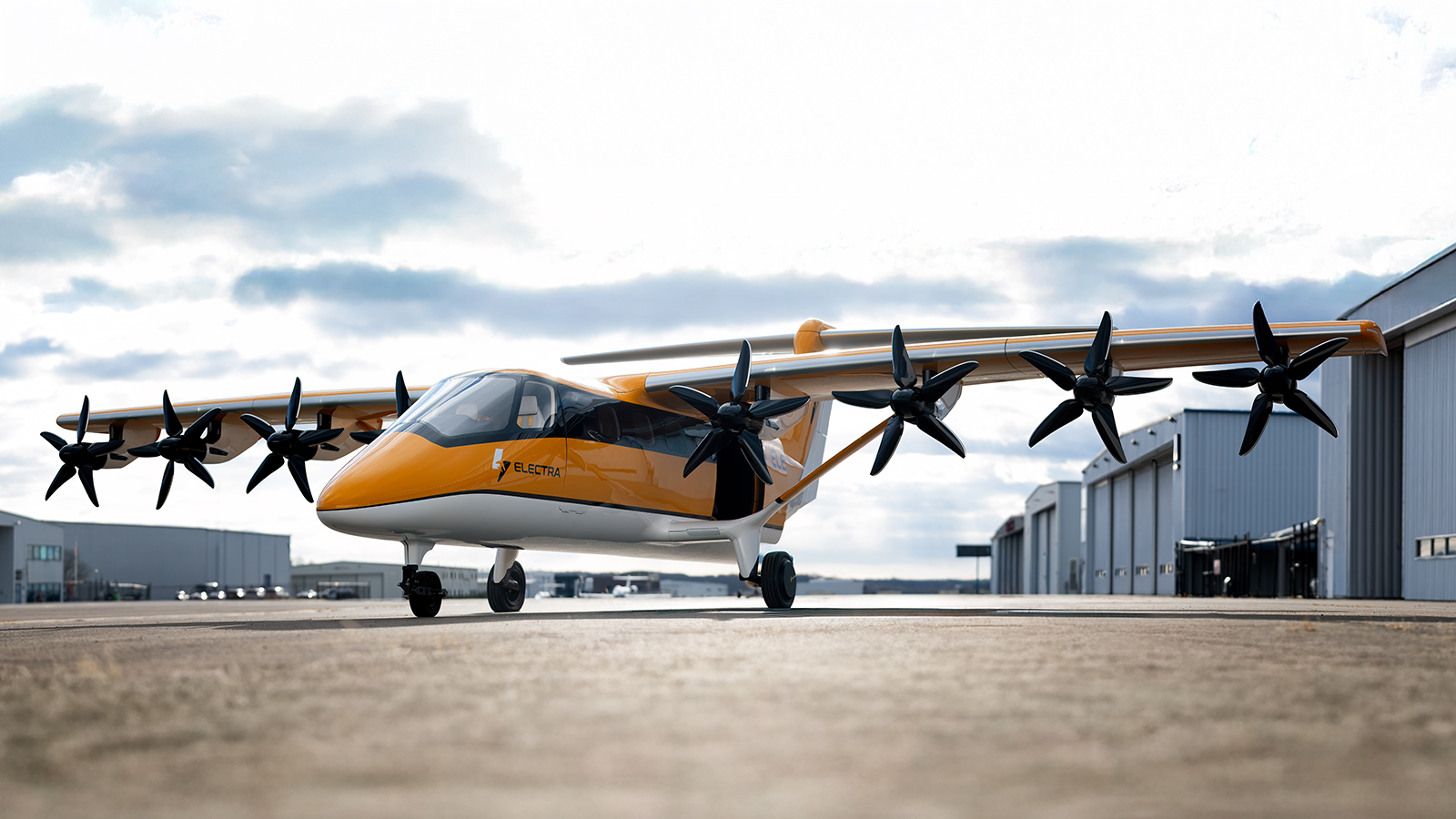
Electric aircraft startup Electra has introduced its hybrid-electric EL9 aircraft, positioning it as a vital resource for the Pentagon and its tactical air needs. The company’s recent establishment of a defense business unit aims to cater to military requirements, particularly in ultra-short takeoff and landing capabilities. During a visit to their facility in Manassas, Virginia, CEO Marc Allen expressed the ambition to “fundamentally transform air travel” with this innovative aircraft.
The EL9 is designed to carry up to nine passengers or a maximum of 3,000 pounds of cargo. This flexibility could be crucial for the military in various scenarios, such as resupply missions or special operations, especially in austere conditions. “Runway independence or runway agnosticism is a missing part of the puzzle,” Allen said, highlighting the aircraft’s potential to meet a key operational requirement in military planning.
Still in its development phase, the EL9 showcased as a full-scale model in the hangar is set to enter the prototype phase with a planned first flight anticipated in late 2027 or early 2028. The company aims to achieve certification with the Federal Aviation Administration (FAA) by 2029, which would allow for commercial operations. On the day of the visit, Electra announced the submission of its application for the EL9’s Part 23 type certification.
Innovative Design and Capabilities
The EL9’s design deviates from traditional aircraft with its eight electric rotors strategically positioned along a fixed wing. This setup enables the aircraft to utilize a technique known as “blown lift,” where motors direct air over the wings, facilitating ultra-short takeoff and landing. Donn Yates, head of Electra’s government programs and a former executive at Boeing, elaborated that the aircraft will cruise at a maximum speed of 175 knots (approximately 200 mph) and operate between 8,000 and 12,000 feet.
The EL9 also boasts 600 kilowatts of power, allowing it to serve as a mobile power station for other systems. The onboard gas generator continuously charges the aircraft’s batteries, providing a reliable power source that can act as a backup if needed. Yates noted that advancements in distributed electric propulsion technology have made the EL9’s design feasible, reducing the weight previously considered prohibitive for such innovations.
The Pentagon has already shown interest in the EL9, particularly for its application in the Air Force’s Agile Combat Employment strategy, which emphasizes flexibility in operations to counter threats to fixed installations. Previously, the Air Force contracted with Electra for an $85 million strategic funding initiative, under which the company tested an earlier technology demonstrator known as “Goldfinch.”
Market Potential and Future Plans
Electra envisions the EL9 as a crucial connector for military operations across the Indo-Pacific, capable of taking off and landing in challenging environments such as small clearings or unprepared strips. This capability would complement larger airlift platforms like the C-17 and C-130, offering an economical solution for transporting smaller cargo loads.
Yates emphasized the growing need for such an aircraft, comparing it to an “Amazon Sprinter van of the sky.” This analogy highlights the EL9’s anticipated role in efficiently moving personnel and supplies, particularly for clandestine missions where noise reduction is essential.
While the military’s interest is evident, commercial opportunities are also on the horizon. Electra is currently exploring manufacturing sites and reports a backlog of 2,200 aircraft orders. The company aims to ramp up production significantly, with plans to build hundreds of units annually, akin to the production levels of major manufacturers like Boeing and Airbus.
The EL9 is expected to enter service around the turn of the decade, with production scaling up progressively in the following years. As Electra continues to develop this innovative aircraft, it positions itself at the forefront of a potential revolution in tactical air transport, catering to both military and commercial markets.