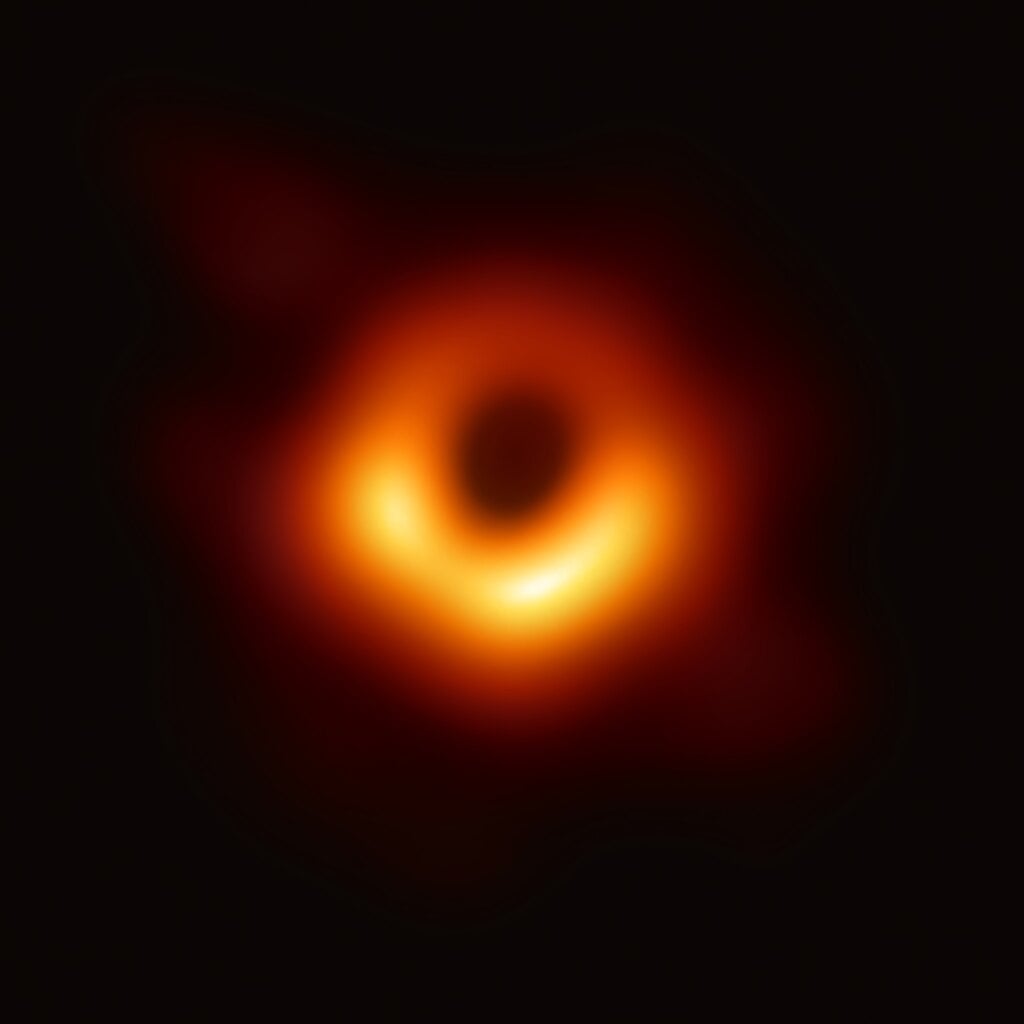
A new £4 million research initiative aims to revolutionize our understanding of black holes by producing the first three-dimensional movies of these cosmic giants. Led by Dr. Kazunori Akiyama, a key figure behind the first images of black holes, and Professor Yves Wiaux from Heriot-Watt University, the project, named TomoGrav, seeks to visualize the complex dynamics of plasma and magnetic fields surrounding black holes.
The groundbreaking images of black holes captured in 2019 and 2022 provided humanity’s first direct visual proof of these enigmatic entities. The first photograph, showcasing the supermassive black hole M87*, was hailed as a monumental achievement in astronomy. Following that, the image of Sagittarius A*, located at the heart of our Milky Way, captivated millions. Yet, these 2D snapshots only scratched the surface of understanding the intricate behaviors of matter in such extreme gravitational environments.
The TomoGrav project aims to address this limitation by creating comprehensive 3D visualizations that illustrate how plasma behaves over time. By employing advanced algorithms, the research team plans to translate the incomplete data gathered by the Event Horizon Telescope (EHT) into dynamic representations of black hole activity. This telescope network, which combines radio observatories worldwide, acts as a virtual Earth-sized lens, capturing details that would otherwise remain hidden.
Dr. Akiyama, who developed one of the imaging algorithms for the initial black hole photographs, emphasizes the significance of these 3D movies. He notes that understanding the rotation of black holes is crucial, as this spin influences the amount of energy extracted from infalling matter. The energy released powers colossal jets that extend thousands of light years into space, playing a vital role in galaxy formation and evolution.
The TomoGrav project promises to unveil the formation processes of these jets by producing time-resolved 3D maps of magnetic fields and plasma around black holes. For the first time, scientists will observe how matter spirals inward and generates the magnetic fields that channel energy outward.
Additionally, this research offers an opportunity to test Einstein’s general relativity under extreme conditions. The team will collaborate with the proposed Black Hole Explorer space mission, which aims to accurately map photon rings—light that has orbited a black hole multiple times before escaping. These measurements will provide insights into gravitational effects at their most intense, where spacetime is severely bent.
The implications of the TomoGrav project extend beyond black hole physics; they could reshape our understanding of fundamental astrophysical processes. As the team embarks on this pioneering journey, the prospect of exploring the unseen dynamics of black holes holds the promise of advancing both theoretical and observational astrophysics significantly. Through these efforts, scientists hope to illuminate some of the universe’s most profound mysteries, bringing us closer to comprehending the forces that govern our cosmos.