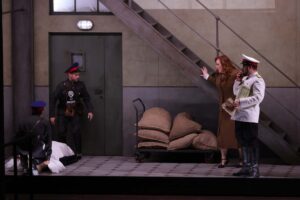
The 2025-2026 season of Teatro alla Scala opened with a striking new production of Lady Macbeth of the Mtsensk District, an opera by Dmitri Shostakovich that challenges traditional narratives and confronts societal issues. Composed between 1930 and 1932, this seminal work has been hailed as one of the most audacious pieces in the operatic canon. Riccardo Chailly, the esteemed conductor, orchestrated the performance, marking his final season-opening appearance in this role.
At its 1934 premiere, “Lady Macbeth” garnered immense acclaim, both in the Soviet Union and internationally. However, it faced a drastic shift in reception when the Soviet newspaper Pravda labeled it “Chaos instead of music” in a notorious 1936 editorial. This denunciation not only led to the opera’s ban but also signified a profound rift between Shostakovich and the Stalinist regime.
Vasily Barkhatov, the director of the new production, set the narrative within the context of Stalin’s Soviet Union, heightening the opera’s themes of oppression and control. By framing the story around a police interrogation, Barkhatov effectively juxtaposes the protagonist’s struggles with the broader societal constraints imposed by the state. The innovative staging transitions between the interrogation and flashbacks, allowing audiences to engage with the characters’ plight without confusion.
The set design by Zinovy Margolin contrasts the façade of a bourgeois restaurant with grim, prison-like interiors, encapsulating the tension between social status and personal despair. Barkhatov’s visual narrative emphasizes psychological and political dimensions, steering clear of folkloric clichés while portraying explicit violence that remains grounded in the opera’s thematic essence.
A pivotal moment in Barkhatov’s interpretation occurs in the updated climax. Instead of Katerina drowning in icy waters, as originally penned, she ignites herself and her companion, Sonetka, with gasoline. This audacious choice leaves the audience stunned, with the physical heat of the flames felt in the theatre. Stuntwomen Beatrice Del Bo and Marie Schmitz execute this daring scene, showcasing remarkable bravery in their performances.
Chailly’s interpretation of the score stood out for its clarity and emotional depth. He deftly navigated the diverse elements of Shostakovich’s composition, from its modernist harshness to its lyrical poignancy. His performance during the season opener was particularly impressive, despite a medical emergency on December 10 that briefly sidelined him. Remarkably, he returned to conduct again on December 13, demonstrating his dedication to the production.
The Orchestra of Teatro alla Scala responded with an exceptional performance, with the brass and percussion sections delivering powerful interpretations of Shostakovich’s complex score. The strings created a soundscape that resonated with the opera’s themes of despair and alienation, while the Teatro alla Scala Chorus, under the direction of Alberto Malazzi, embodied the collective societal struggles depicted in the opera.
At the center of the production was Sara Jakubiak, whose portrayal of Katerina Izmailova was both technically skilled and emotionally resonant. Jakubiak captured the character’s despair, offering a nuanced performance that depicted Katerina as a victim of her circumstances rather than a mere villain. Her mastery of the role has been recognized as among the best in contemporary performances.
Alongside her, Najmiddin Mavlyanov provided a compelling portrayal of Sergei, emphasizing the character’s opportunistic traits rather than romanticized heroism. The performance of Alexander Roslavets as Boris further anchored the production, embodying the oppressive patriarchal figure with a voice that conveyed both power and menace.
The strong performances extended to the supporting cast, with Ekaterina Sannikova and Elena Maximova delivering memorable interpretations that added depth to the narrative. The ensemble’s professionalism contributed to a cohesive and impactful theatrical experience.
As the curtain fell, the audience responded with enthusiastic applause, particularly for Chailly and Jakubiak, whose contributions were pivotal to the production’s success. The enduring resonance of Shostakovich’s work, with its timeless critique of power and repression, continues to engage and provoke audiences, reaffirming its place in the operatic repertoire.