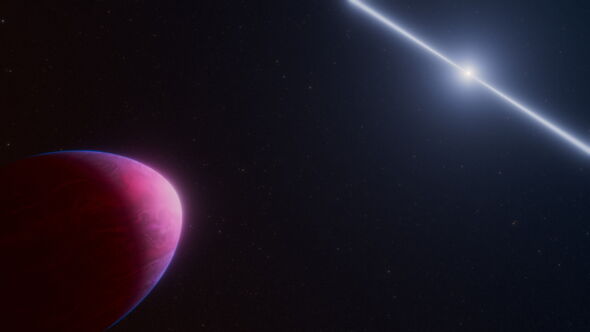
NASA has announced the discovery of an extraordinary exoplanet, designated **PSR J2322-2650b**, which features a peculiar lemon-like shape and an atmosphere unlike any previously observed. Utilizing the advanced capabilities of the **James Webb Space Telescope (JWST)**, the research team identified this unique celestial body orbiting a pulsar, a type of dead star.
The mass of PSR J2322-2650b is comparable to that of **Jupiter**, yet its characteristics diverge sharply from those of traditional planets. This discovery adds to the intrigue surrounding exoplanets, which are planets that orbit stars outside our solar system. The planet’s unusual morphology and atmospheric composition have left scientists intrigued and searching for explanations.
Unraveling the Planet’s Unique Features
Team member **Peter Gao** from the **Carnegie Earth and Planets Laboratory** expressed his astonishment, stating, “This was an absolute surprise. I remember after we got the data down, our collective reaction was, ‘What the heck is this?’ It’s extremely different from what we expected.” The atmosphere of PSR J2322-2650b is primarily composed of helium and carbon, with indications that clouds of carbon soot may condense to form diamonds, which could potentially rain down on the planet’s surface.
The planet orbits its pulsar parent star at a mere **1 million miles** distance, completing a circuit approximately every **8 hours**. The unusual ellipsoid shape results from tidal forces caused by the intense gravitational pull of the pulsar. **Michael Zhang**, the principal investigator from the **University of Chicago**, noted, “The planet orbits a star that’s completely bizarre — the mass of the Sun, but the size of a city. This is a new type of planet atmosphere that nobody has ever seen before.”
A Unique Observational Opportunity
The researchers highlight the unique observational opportunities presented by this system. According to **Maya Beleznay**, a graduate student at **Stanford University**, “This system is unique because we are able to view the planet illuminated by its host star, but not see the host star at all. So we get a really pristine spectrum. And we can better study this system in more detail than normal exoplanets.”
PSR J2322-2650b is part of what could be termed a “black widow” system, a rare configuration where a rapidly spinning pulsar is accompanied by a small, low-mass companion. In typical black widow systems, the pulsar gradually erodes its partner star through intense radiation and high-energy particles. However, in this instance, the International Astronomical Union officially categorizes PSR J2322-2650b as an exoplanet, not a star.
Zhang further elaborated on the planet’s formation, stating, “Did this thing form like a normal planet? No, because the composition is entirely different. Did it form by stripping the outside of a star, like ‘normal’ black widow systems are formed? Probably not, because nuclear physics does not make pure carbon.”
The discovery of PSR J2322-2650b opens new avenues for research into exoplanets and their atmospheres. As scientists continue to analyze data from the JWST, they hope to uncover further insights into the origins and evolution of such unusual planetary bodies.