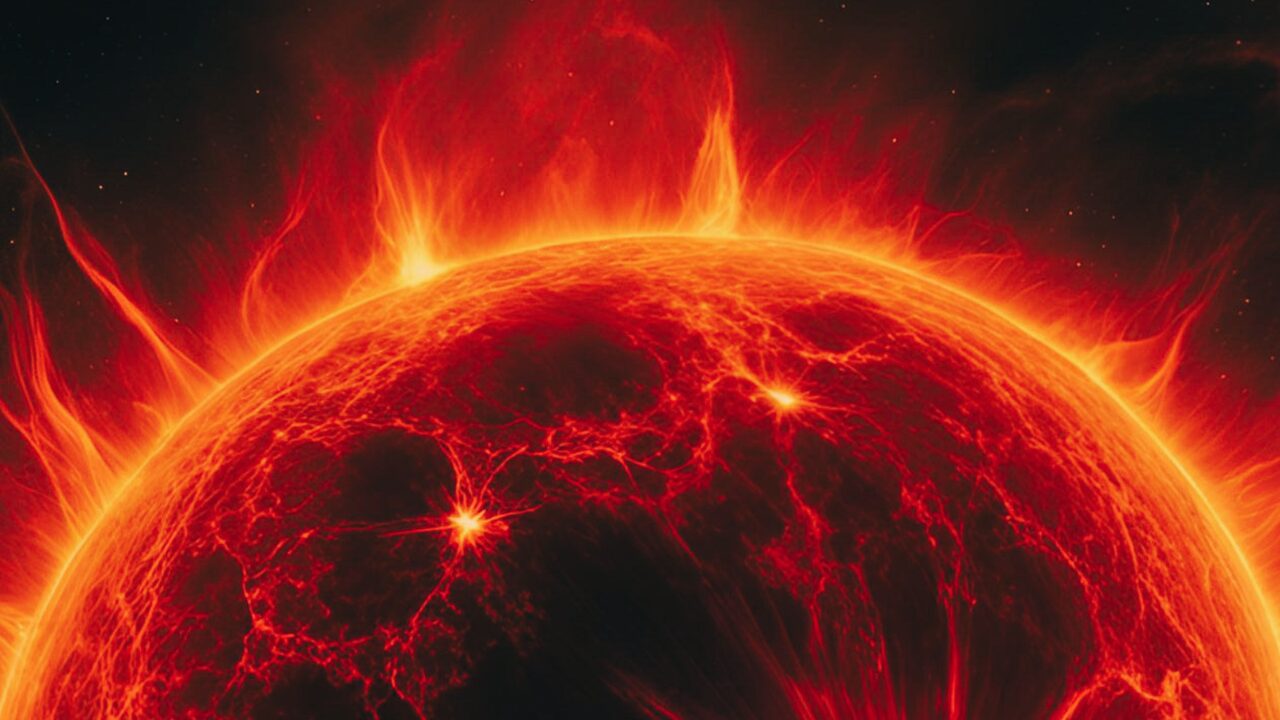
Using the James Webb Space Telescope (JWST), astronomers have potentially discovered the first evidence of extraordinarily massive stars, termed “monster stars,” that existed shortly after the Big Bang. These stellar giants are believed to have had masses up to 10,000 times that of the sun. While these ancient stars no longer exist, their remnants can be traced through the black holes they left behind, which may shed light on the formation of supermassive black holes in the early universe.
The JWST’s groundbreaking findings emerged from a study of a galaxy known as GS 3073, located approximately 12.7 billion light-years from Earth. This galaxy is observed as it existed just 1.1 billion years after the Big Bang. The key piece of evidence was an unusual nitrogen-to-oxygen ratio in GS 3073, which cannot be explained by current models of stellar formation.
Discovering Cosmic Fossils
Astronomers identified a nitrogen-to-oxygen ratio of 0.46 in GS 3073, significantly higher than what any known stars or stellar explosions can produce. According to Daniel Whalen, a team member from the University of Portsmouth, this discovery resolves a longstanding cosmic mystery. “With GS 3073, we have the first observational evidence that these monster stars existed,” he stated.
Whalen likened these cosmic giants to dinosaurs, pointing out their massive size and brief lifespans. “These cosmic giants would have burned brilliantly for a brief time before collapsing into massive black holes, leaving behind the chemical signatures we can detect billions of years later,” he noted.
The research team, including Devesh Nandal from the Center for Astrophysics at Harvard and Smithsonian, explained that the unique chemical abundance in GS 3073 acts as a “cosmic fingerprint.” The extreme nitrogen levels match only one known source: primordial stars that were thousands of times more massive than the sun.
Understanding Stellar Formation and Black Holes
To further comprehend the significance of these findings, the team modeled the evolution of stars with masses ranging from 1,000 to 10,000 solar masses. Their simulations suggested that these massive stars created significant amounts of nitrogen through fusion processes, enriching the surrounding gas.
As these stars reached the end of their lifecycles, they likely collapsed directly into black holes without experiencing a supernova explosion. This means they could have formed black holes with masses thousands of times that of the sun, potentially leading to the formation of supermassive black holes observed today.
The galaxy GS 3073 contains a feeding supermassive black hole that could be the result of mergers between black holes formed by these primordial stars. The research team plans to continue their investigation by searching for other nitrogen-rich galaxies in the early universe, which will strengthen the case for the existence of these monster stars.
This pivotal research was published in The Astrophysical Journal Letters in November, marking a significant advancement in our understanding of the universe’s early cosmic history. As scientists continue to explore these ancient phenomena, the implications for our knowledge of black hole formation and the evolution of galaxies remain profound.