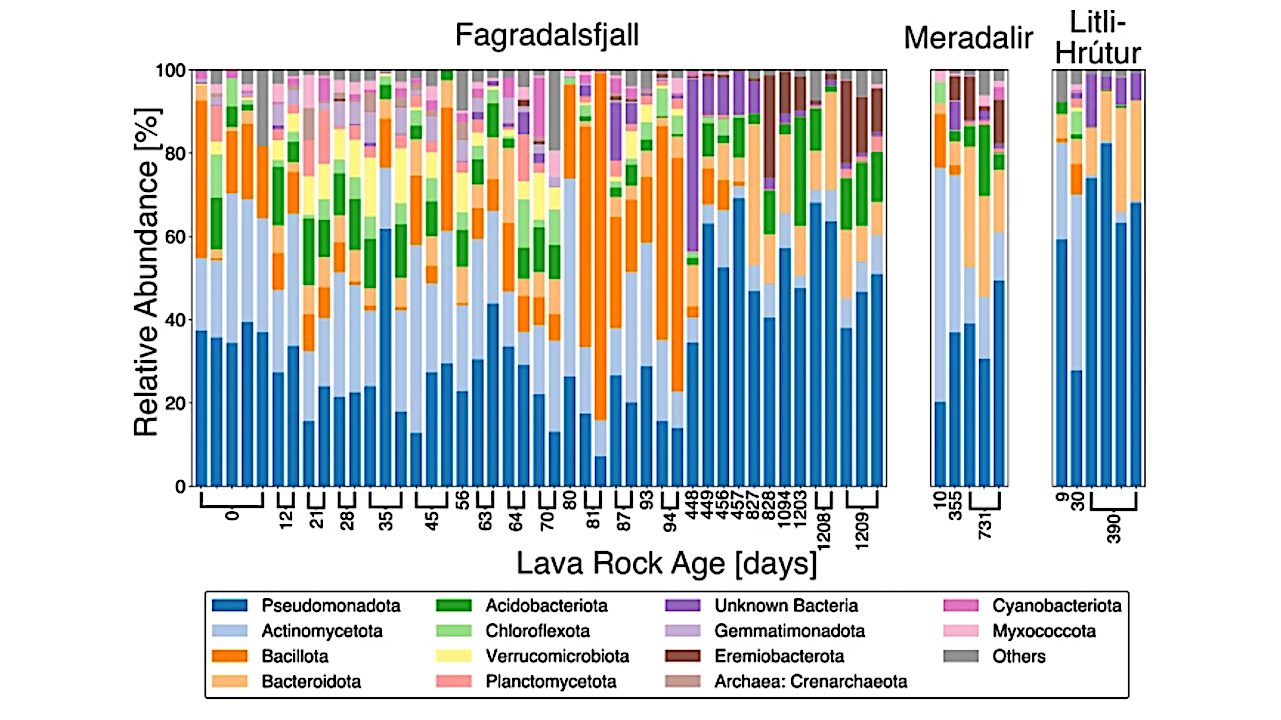
Research conducted on the recent eruptions of the Fagradalsfjall Volcano in Iceland has shed light on how microbial communities establish themselves in newly formed environments. Over the course of three years, from 2021 to 2023, scientists tracked the colonization of microbial life on fresh lava, providing valuable insights into ecological succession.
The study utilized the volcanic eruptions as a natural experiment, allowing researchers to observe microbial colonization on lava that solidified just hours prior to sample collection. By collecting data biweekly during the initial eruption phase in 2021 and at various intervals over the following years, the researchers compiled a comprehensive temporal dataset that captures the primary succession process.
Insights from the Eruptive Phases
The eruptions at Fagradalsfjall were not isolated events. As the volcano erupted again in 2022 and 2023, researchers were able to monitor the ecological development across multiple episodes, creating a unique opportunity to observe natural ecological triplicates. The research employed a range of analytical techniques, including alpha and beta diversity measurements, phylogenetic null modeling, taxa volatility analysis, and Bayesian source tracking.
This investigation led to a two-stage model of microbial community assembly. The first stage is characterized by the rapid establishment of a diverse microbial assemblage. Following this initial phase, the second stage involves stabilization, particularly as winter sets in. The findings suggest that despite the harsh conditions, microbial colonization follows a dynamic yet predictable pattern.
Strong predictive capabilities were demonstrated through a random forest regression model, which was trained on community data from the 2021 eruption. This model accurately predicted the stages of microbial succession observed in the subsequent eruptions of 2022 and 2023.
Implications for Understanding Earth’s Ecosystems
This study, published in Communications Biology, emphasizes the importance of microbial life in shaping ecosystems, particularly in extreme environments like volcanic regions. The predictable nature of microbial colonization offers crucial insights into primary succession, which is fundamental to ecological theory and practice.
As scientists continue to explore how life can thrive in seemingly inhospitable conditions, the research from Fagradalsfjall serves as an important reminder of the resilience and adaptability of microbial communities. Understanding these processes not only enriches ecological knowledge but also has potential implications for astrobiology and the search for life in extreme environments beyond Earth.
With ongoing studies planned for 2024 to further investigate spatial variability, the Fagradalsfjall eruptions continue to be a focal point for understanding the complexities of life’s establishment in new habitats.