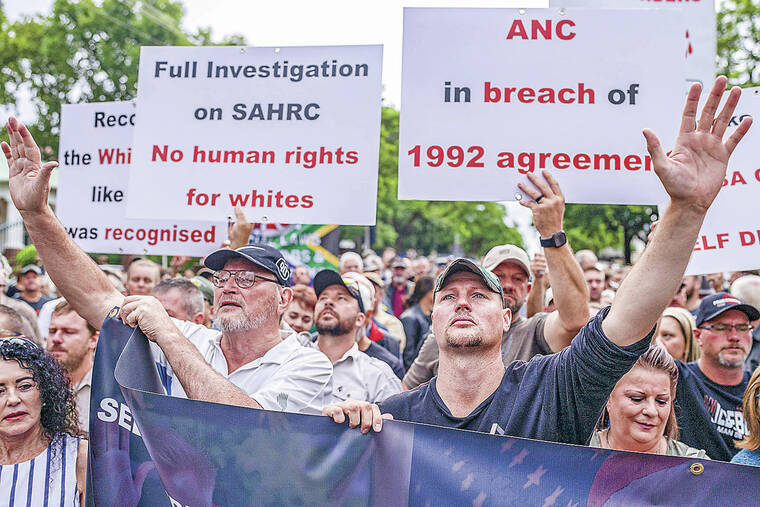
UPDATE: In a surprising turn of events, Afrikaner leaders have gained unprecedented access to U.S. diplomats in South Africa, a shift attributed to the policies of the Trump administration. This new engagement marks a significant change for Afrikaners, who have historically been sidelined in diplomatic discussions.
PRETORIA, South Africa — Prominent Afrikaner figures, including Theo de Jager, recently visited Washington and were met with unexpected enthusiasm from U.S. officials. During their meetings, they discussed critical topics such as the plight of white farmers in South Africa, a subject that has gained traction under the Trump administration.
Since January 2023, President Donald Trump has implemented policies that include halting U.S. aid to South Africa and imposing 30% tariffs on South African imports. These actions are framed by Trump as a response to the alleged persecution of Afrikaners, whom he claims are facing genocide. Furthermore, the administration has made it nearly impossible for anyone but Afrikaners to gain refugee status in the U.S.
The shift is palpable; Afrikaners now enjoy a level of access to U.S. officials that was unimaginable just a year ago. Jaco Kleynhans of the Solidarity Movement stated, “The extent of our access and engagement has increased tremendously in the past 10 months.” He noted that he speaks directly with U.S. government officials on a weekly basis, discussing issues like farm killings and economic policies.
The U.S. Embassy in Pretoria has even begun sharing social media content in Afrikaans, signaling an effort to connect more closely with Afrikaner communities.
“U.S. diplomats routinely engage a variety of civil society organizations in furtherance of U.S. foreign policy priorities,”
said a State Department spokesperson.
This newfound attention is not without controversy. Some South African lawmakers have accused Afrikaner organizations of treason, alleging they spread misinformation that could jeopardize relations with the U.S., a crucial economic partner. Kallie Kriel, CEO of AfriForum, highlighted the risks Afrikaners face in their home country: “Most foreign missions in Pretoria hesitate to engage with us publicly,” he remarked.
The annual Independence Day celebration at the U.S. Embassy this year welcomed a larger-than-usual contingent of Afrikaners, showcasing their increasing visibility. Guests, including Gerhard Papenfus, who met with White House officials for the first time, noted the administration’s outreach as unprecedented. “Here’s an administration that reaches out and says, ‘We hear you,’” Papenfus stated.
The positive reception of Afrikaners in Washington has raised eyebrows among former U.S. diplomats. Patrick Gaspard, U.S. ambassador to South Africa from 2013 to 2016, expressed astonishment at the current level of engagement, saying, “Afrikaner organizations were a sidelight, peripheral, and marginal set of actors who had no real sway.”
As tensions rise in South Africa over this diplomatic pivot, the impact on local Afrikaner communities remains to be seen. The situation continues to develop, and observers are watching closely as the Trump administration’s policies continue to influence discussions on human rights and economic partnerships in the region.
What happens next? Both Afrikaner leaders and U.S. officials are expected to maintain open lines of communication, further shaping U.S. policy on South Africa. As this story unfolds, it underscores the complexities of international relations and the evolving dynamics of race and politics in South Africa.