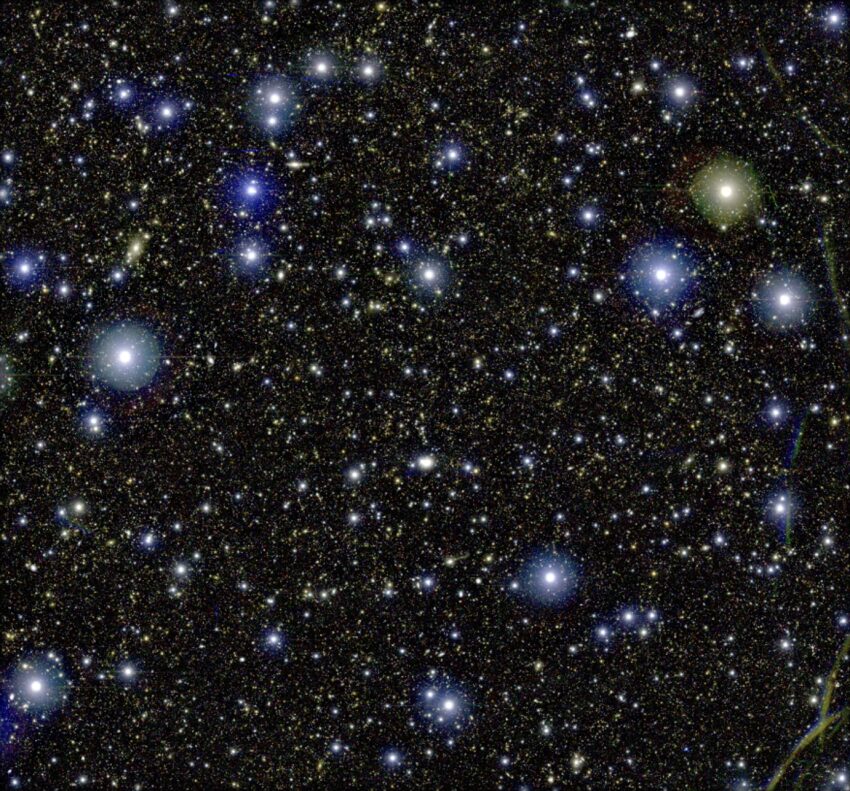
New research from the Deep Extragalactic Visible Legacy Survey (DEVILS) highlights the significant impact of environmental factors on the evolution of galaxies. This initiative, a collaboration between the International Centre for Radio Astronomy Research (ICRAR) and the University of Western Australia, has released its first set of data, which includes morphological, redshift, photometric, and spectroscopic information for thousands of galaxies. The findings were published in the Monthly Notices of the Royal Astronomical Society, with the lead author being Luke Davies, an Associate Professor at the University of Western Australia node of ICRAR.
The release of this comprehensive dataset follows a decade of meticulous observations and data analysis, marking a significant milestone in galaxy research. What sets DEVILS apart from other astronomical surveys is its focus on galaxies that existed up to five billion years ago. By comparing these ancient galaxies to their modern counterparts, researchers are gaining valuable insights into their evolutionary processes.
Understanding Galaxy Growth in Dense Environments
One of the key revelations from the DEVILS data is that galaxies in crowded environments tend to grow at a slower rate than those in isolation. “Galaxies can be broadly classified into two main categories: blue, gas-rich, star-forming systems, and red, gas-poor, quiescent systems with little or no ongoing star formation,” the researchers noted. Initially, all galaxies are believed to start as low-mass, blue, star-forming systems, gradually transitioning into quiescent systems over time as the universe evolves.
In environments characterized by high galaxy density, such as clusters or close pairs, the supply of cold gas—essential for star formation—can be disrupted or removed. This phenomenon leads to what is known as “quenching,” where star formation is significantly inhibited. The research identified several mechanisms responsible for this, including ram-pressure stripping and tidal interactions, which affect the movement of star-forming gas between galaxies.
The visual representations included in the DEVILS data release provide a clearer understanding of these dynamics. They illustrate the distribution of isolated galaxies, group galaxies, and dark matter haloes, highlighting how these structures interact within their environments.
Insights into Cosmic Structures and Future Research
Luke Davies likened the environment of galaxies to that of humans, stating, “Our upbringing and environment influence who we are. Someone who has lived their whole life in the city may have a very different personality compared to someone who lives remotely or in an isolated community. Galaxies are no different.” This analogy underscores the profound effect that cosmic environments have on the structural and evolutionary characteristics of galaxies.
The dataset also reveals strong correlations between star formation rates and local galaxy density, showing that as local density increases, star formation rates tend to decrease. Conversely, the data indicates weak trends of increasing stellar mass with local density, suggesting that while the growth rate slows, more massive galaxies may form in denser environments.
Looking ahead, Davies and his team aim to expand on the findings of DEVILS with the upcoming WAVES (Wide Area VISTA Extragalactic Survey). This new project will allow researchers to study an even larger number of galaxies and their environments, further enhancing our understanding of galaxy evolution and the cosmic landscape.
The DEVILS initiative exemplifies the potential of large-scale astronomical surveys to unravel the complexities of galaxy formation and evolution. As researchers continue to analyze the data, they are poised to uncover further insights that could reshape our understanding of the universe and its myriad galaxies.